

How AI Is Reshaping Medicine for Nearly Half the World's Population
Across Asia-Pacific, artificial intelligence is no longer a pilot programme or a PowerPoint promise. It is operating inside hospitals, clinics, and mobile health platforms at a scale and speed that has few precedents in modern medicine. From robotic nursing care in Tokyo to AI-powered✦ cancer screening in Seoul, and rural telemedicine reaching the furthest corners of India, the AI healthcare revolution in Asia has moved decisively from experimentation into clinical mainstream.
The numbers are striking. The ambitions are even more so. For a region carrying nearly 60% of the world's population, the implications are genuinely profound.
By The Numbers
- 340% increase in AI clinical trials across the WHO Asia-Pacific region since 2023
- 67 AI medical devices approved by Chinese regulators in 2025 alone
- 400 million rural patients now served by India's AI telemedicine platforms
- 60% reduction in diagnostic wait times achieved by Thailand's AI pathology network
- 200% surge in adoption of mental health AI chatbots across Southeast Asia
From Diagnostics to Drug Discovery: The Clinical Shift
The most visible sign of AI-powered healthcare in Asia-Pacific is the rapid integration of diagnostic tools into clinical workflows. AI-assisted imaging, pathology analysis, and risk scoring are no longer confined to academic medical centres. They are being deployed at scale✦ in public health systems that serve hundreds of millions of patients annually.
South Korea has taken one of the most decisive regulatory steps in the region, mandating AI-assisted cancer screening as a covered benefit under its national health insurance scheme from 2026. This single policy decision positions AI diagnostics not as an optional premium add-on but as a standard of care, affecting tens of millions of South Koreans who rely on the national system.
"67 AI medical devices approved by Chinese regulators in 2025 alone" - China's National Medical Products Administration
China's regulatory pipeline tells its own story. With 67 AI medical devices cleared in a single year, Beijing has accelerated approvals in areas including radiology, ophthalmology, and cardiovascular risk assessment. The sheer volume reflects both the maturity of China's domestic AI health sector and the political priority placed on modernising its vast hospital network.
Meanwhile, Google DeepMind's AlphaFold protein-structure prediction platform continues to reshape drug discovery timelines globally, with particular relevance for Asia. Diseases with disproportionate prevalence in the region, including tuberculosis, dengue fever, and various neglected tropical diseases, are now the subject of accelerated research programmes that would have been computationally impossible five years ago.
Japan, India, and Singapore Lead Structural Change
Three countries illustrate the breadth of approaches being taken across the region, each responding to distinct demographic and infrastructure realities.
Japan: Robots for an Ageing Nation
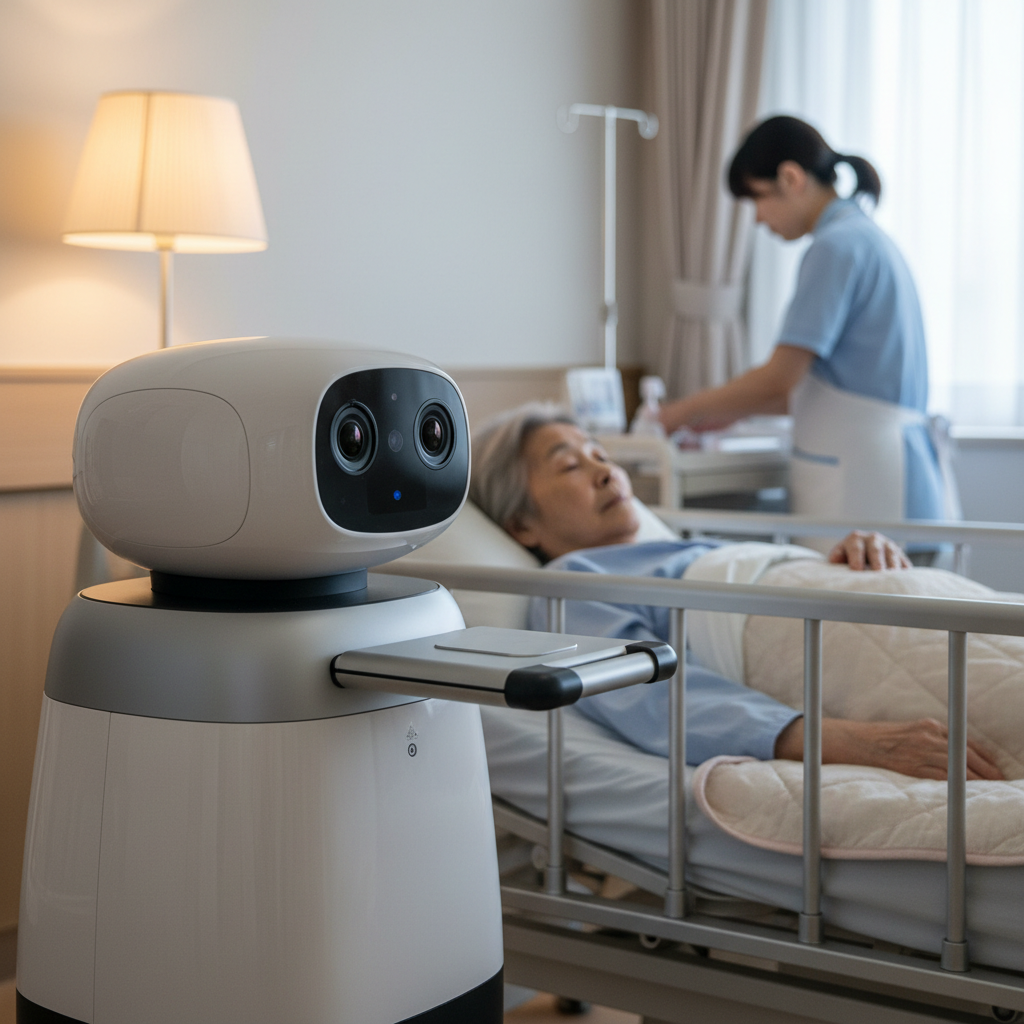
Japan's AI nursing robots are no longer a novelty. With 28% of Japan's population aged over 65, the country faces one of the most acute elderly care crises in the world. AI-driven✦ robotic systems are being deployed in care homes and hospital wards to assist with patient monitoring, mobility support, and routine care tasks, freeing human nurses for work that demands clinical judgement and emotional intelligence.
The urgency is structural. Japan faces a projected shortfall of hundreds of thousands of care workers over the coming decade. AI and robotics are not a preference; they are a necessity. This context explains why Japan's government has been among the most proactive in the region in funding and fast-tracking healthcare robotics. The broader trajectory of physical AI capabilities, including how advanced robotics are acquiring new physical dexterity through reinforcement learning, is directly relevant to where care robotics is heading next.
India: Telemedicine at Civilisational Scale
India's challenge is the inverse of Japan's. Rather than too few workers for an ageing population, India confronts a vast rural population with insufficient access to any specialist care at all. AI telemedicine platforms have stepped into this gap with remarkable effect, now serving an estimated 400 million rural patients across the subcontinent.
These platforms combine AI-driven triage and symptom assessment with video consultations, enabling patients in remote villages to access the equivalent of specialist-level screening without travelling to urban centres. The productivity and access implications here rival anything happening in more heavily funded Western health systems. For smaller providers looking to apply similar logic, the practical lessons from small business AI adoption offer a useful counterpoint to the enterprise-scale narrative.
Singapore: The AI-First Health Strategy
Singapore has launched a nationally coordinated AI-first health strategy centred on predictive diagnostics and preventive care. As a city-state with high digital infrastructure density and a relatively small, well-documented patient population, Singapore is well positioned to serve as a proof-of-concept for AI-integrated national health systems. Its approach emphasises using AI not just to treat disease after it presents, but to identify and intervene before it does.
"The WHO Asia-Pacific region reports a 340% increase in AI clinical trials since 2023" - World Health Organisation
This regional momentum sits within a wider context of surging enterprise investment. As detailed in our coverage of APAC enterprise AI hitting a USD 50 billion surge in sovereign and institutional funding, capital is flowing into AI infrastructure at a rate that will sustain this healthcare transformation for years to come.
Mental Health and the Southeast Asia Surge
One of the most significant and perhaps underreported dimensions of the AI healthcare revolution in Asia is the explosion in mental health applications across Southeast Asia. A 200% surge in the adoption of AI mental health chatbots reflects both unmet demand and the particular social dynamics of stigma around mental illness in many parts of the region.
- AI chatbots provide 24-hour access without the social exposure of seeking in-person help
- Language localisation allows platforms to serve users in Bahasa, Thai, Vietnamese, and Tagalog
- Integration with national health portals is beginning in several ASEAN countries
- Clinical oversight models vary significantly, raising serious questions about safety and efficacy standards
The adoption surge brings with it serious questions about clinical governance. Chatbot-based mental health support operates in a regulatory grey zone in most of the region, and the gap between popularity and clinical validation is a risk that policymakers are only beginning to address. Vietnam's recent move to establish a formal AI regulatory framework✦, examined in detail in our piece on Vietnam enforcing Southeast Asia's first standalone AI law, signals that this is beginning to change.
Thailand's Pathology Network: A Model for Middle-Income Systems
Thailand's AI pathology network deserves particular attention as a replicable model for middle-income health systems. By deploying AI-assisted slide analysis across a distributed network of hospitals, Thailand has achieved a 60% reduction in diagnostic wait times, a metric with direct consequences for cancer survival rates where early detection is critical.
The Thai model demonstrates that the benefits of AI diagnostics are not confined to wealthy health systems with abundant specialist staff. With the right infrastructure and regulatory framework, AI can compress the gap between high-income and middle-income healthcare quality significantly. This is perhaps the most important lesson the region has to teach the rest of the world.
| Country | Primary AI Health Application | Key Metric |
|---|---|---|
| Japan | AI nursing and care robotics | 28% of population aged 65+; acute care worker shortage |
| South Korea | AI cancer screening (national insurance) | Mandated from 2026 under national health scheme |
| India | AI telemedicine for rural access | 400 million rural patients served |
| China | AI medical device approvals | 67 devices approved in 2025 |
| Singapore | Predictive diagnostics, AI-first national strategy | National strategy launched 2025/26 |
| Thailand | AI pathology network | 60% reduction in diagnostic wait times |
The Asia-Pacific Picture: What This Means at Scale
Asia-Pacific is not simply adopting AI healthcare tools developed elsewhere. The region is generating its own innovations, regulatory models, and deployment strategies, often under conditions of resource constraint that produce genuinely novel solutions. The 340% increase in AI clinical trials since 2023 reflects a research ecosystem✦ that is now producing, not just consuming, the evidence base for AI-driven medicine in Asia.
The scale factor is genuinely different here. When India's telemedicine platforms or China's diagnostic AI networks achieve meaningful clinical outcomes, they do so across populations larger than entire continents. The compounding effect of AI improvements at this scale is difficult to overstate.
There are, of course, risks. The productivity gains from AI tools can mask workforce pressures and create new forms of dependency. The question of what happens when AI systems fail at scale, in health systems with limited fallback capacity, deserves more serious attention than it is currently receiving. Our coverage of the cognitive and organisational costs of AI over-reliance explores how dependency on AI systems creates new vulnerabilities that institutions are slow to acknowledge.
Data governance is another fault line. The patient data required to train and improve AI diagnostic systems is both enormously valuable and deeply sensitive. Across Asia-Pacific, approaches to health data sovereignty✦ vary enormously, from Singapore's tightly governed frameworks to far less formalised arrangements elsewhere in the region. Regulatory coherence across ASEAN in particular remains a work in progress.
Frequently Asked Questions
Which Asian country is furthest ahead in AI healthcare adoption?
It depends on the metric. China leads on volume of approved AI medical devices, with 67 cleared in 2025 alone. South Korea is furthest ahead on policy integration, having mandated AI cancer screening under national health insurance from 2026. Singapore leads on strategic coordination, with a nationally directed AI-first health strategy. Japan is most advanced in care robotics. Each represents a different dimension of AI healthcare maturity.
Are AI mental health chatbots in Asia clinically regulated?
In most of the region, not yet. Mental health AI chatbots occupy a regulatory grey zone in the majority of ASEAN markets. Vietnam has introduced the region's first standalone AI law, which may create a framework others follow. South Korea and Singapore have more developed digital health regulatory regimes, but chatbot-specific clinical standards remain underdeveloped across the board.
How is AlphaFold relevant to Asia-specific disease research?
Google DeepMind's AlphaFold predicts the three-dimensional structure of proteins, dramatically accelerating the identification of drug targets. For Asia-Pacific, this is particularly significant for diseases prevalent in the region, including tuberculosis, dengue, and neglected tropical diseases, where traditional drug discovery timelines were a major barrier to developing effective treatments.
Given that AI is now making diagnostic decisions that affect hundreds of millions of patients across Asia, we want to know: how much do you trust an AI system to play a role in your own medical care, and what would it actually take to change that? Drop your take in the comments below.






Latest Comments (2)
South Korea's decision to mandate AI-assisted cancer screening as a covered benefit from 2026 really highlights the regulatory foresight being exercised in Asia. From a UK government perspective, establishing such a precedent requires robust ethical frameworks and governance, something we're actively exploring with the AI Safety Institute for similar large-scale adoptions here.
the mention of robotic nursing care in Tokyo is interesting. as a dev working with japanese LLMs, I'm curious how deeply these robots integrate conversational AI. is it mostly physical assistance, or are the language models handling complex patient communication and emotional support? adapting that for local nuances must be a huge project.
Leave a Comment