How Amazon and UC Berkeley Taught a Robot to Do Parkour
Humanoid robots have long promised to handle real-world tasks alongside humans, but agile, dynamic movement has remained stubbornly out of reach. Walking on flat ground is solved. Navigating a rubble-strewn disaster site or vaulting over a barrier at speed is another matter entirely. A new research framework from Amazon Frontier AI & Robotics and the University of California, Berkeley is changing that calculus in a meaningful way.
The system, called Perceptive Humanoid Parkour (PHP), enables a Unitree G1 humanoid robot to execute fluid, contact-rich movements drawn directly from human parkour practitioners. The research was published on the arXiv preprint server in early 2026, and the results are striking enough to warrant serious attention from anyone watching the convergence of robotics and artificial intelligence.
By The Numbers
- 3 m/s: the speed at which the Unitree G1 robot executes cat-vaults and speed-vaults over obstacles
- 1.25 metres: the maximum wall height the robot can climb onto, equivalent to 96% of the robot's own height
- 60 seconds: duration of a continuous, autonomous traversal of a complex multi-obstacle parkour course with seamless skill transitions
- Single policy: the entire suite of parkour behaviours is controlled by one unified visuomotor policy, not separate task-specific programs
- 2 key institutions: Amazon Frontier AI & Robotics (FAR) and UC Berkeley jointly developed the PHP framework
What the PHP Framework Actually Does
The core problem with teaching humanoid robots to move dynamically is not hardware. It is the challenge of translating the fluid, opportunistic decision-making of a human body into something a machine can learn and generalise. Previous approaches to humanoid locomotion have produced robots that walk steadily on varied terrain, but human-like agility demands something far more sophisticated: long-horizon planning, real-time perception, and the ability to chain multiple skills together without stopping to recalibrate.
"While recent advances in humanoid locomotion have achieved stable walking on varied terrains, capturing the agility and adaptivity of highly dynamic human motions remains an open challenge." - Zhen Wu, Xiaoyu Huang and colleagues, arXiv (2026)
PHP addresses this through a modular architecture that combines two key components: motion matching and a teacher-student reinforcement learning✦ pipeline. The team first assembled a dataset of human parkour videos, decomposed those movements into reusable atomic actions, and then used nearest-neighbour search in a feature space to compose those actions into smooth, long-horizon movement sequences. The elegance of this approach is that it preserves the fluidity of human motion rather than engineering stiff, mechanical approximations.
From Human Video to Robot Policy
Once the motion matching stage produces kinematic trajectories, the researchers train individual skill controllers using reinforcement learning. RL allows the system to refine movements through iterative trial and error, rewarding the robot for successfully executing each parkour skill. Those individual controllers are then distilled into a single unified policy that uses onboard depth-sensing imagery to make autonomous decisions about which skill to deploy in any given situation.
"Using only onboard depth sensing and a discrete 2D velocity command, the robot selects and executes whether to step over, climb onto, vault or roll off obstacles of varying geometries and heights." - Wu, Huang et al., arXiv (2026)
This perception-driven decision-making is what separates PHP from earlier humanoid movement research. The robot does not need a human operator to select its next move. It reads the environment in real time, chooses the appropriate skill, and executes it, adapting to perturbations mid-course if obstacles shift position. The result is genuine closed-loop autonomy, not a scripted sequence of pre-programmed actions.
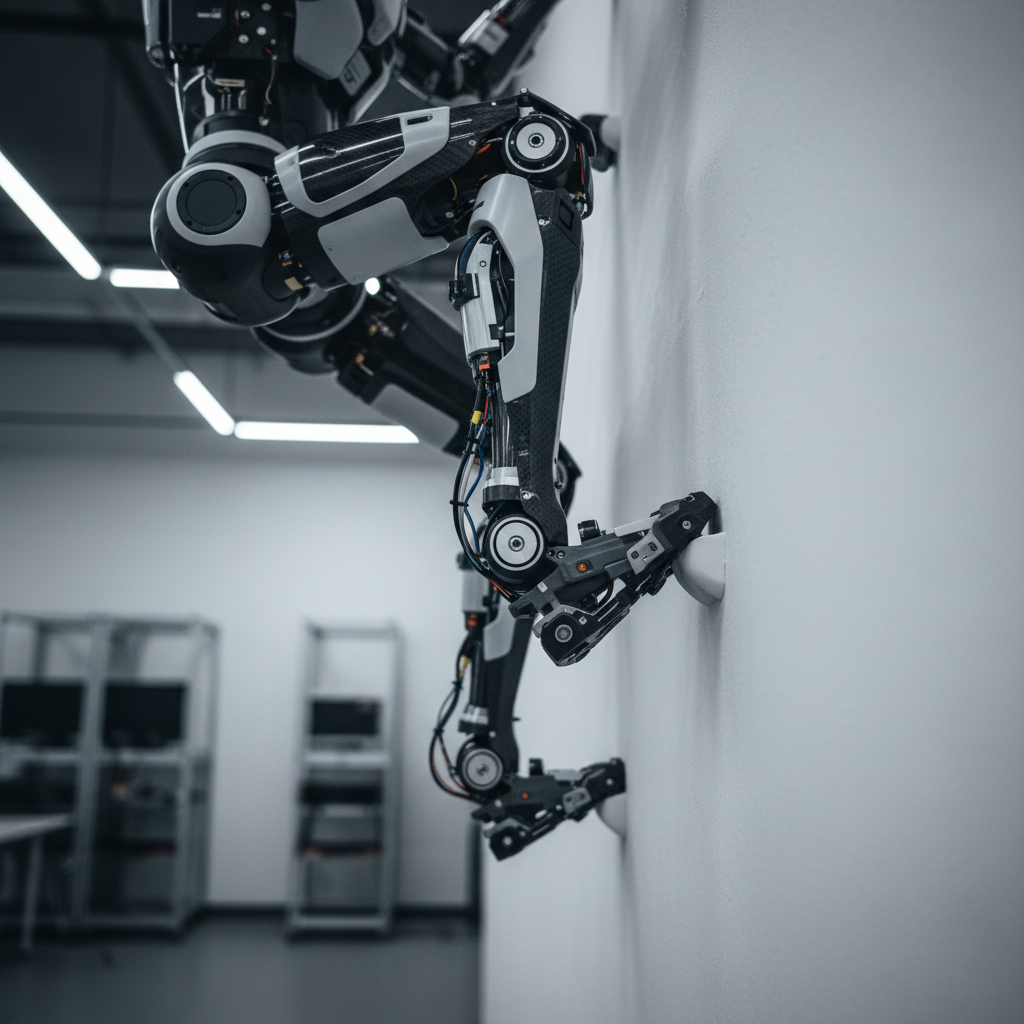
Real-World Results on the Unitree G1
The framework has been validated on the Unitree G1, a humanoid robot developed by Chinese robotics manufacturer Unitree Robotics. The G1 is a commercially available research platform widely used in academic and industrial settings across Asia and internationally. The choice of hardware matters here. Unitree's robots are designed for accessibility and real-world deployment, which means these results are not confined to a bespoke laboratory prototype.
In real-world trials, the G1 demonstrated a range of highly dynamic skills:
- Cat-vaulting over a short obstacle, immediately followed by a dash-vault over a taller barrier, both at approximately 3 m/s
- Climbing onto a 1.25-metre wall (96% of the robot's own height) and rolling down the other side
- Speed-vaulting over obstacles at approximately 3 m/s
- A 60-second continuous autonomous traversal of a complex multi-obstacle parkour course, selecting skills independently and transitioning between them without interruption
These are not controlled single-obstacle demonstrations. The 60-second course traversal with autonomous skill selection and real-time adaptation to obstacle perturbations represents a qualitative leap in what humanoid robots can do in unstructured environments. This is the kind of capability that makes disaster response, industrial inspection, and search and rescue genuinely tractable use cases, not speculative ones.
The Asia-Pacific Picture
The choice of the Unitree G1 as the test platform is not incidental. Unitree Robotics, headquartered in Hangzhou, China, has become one of the most prominent humanoid and quadruped robot manufacturers globally, and its hardware is now a common substrate for cutting-edge✦ locomotion research. This research represents a direct collaboration between US academic and corporate research institutions and Chinese-manufactured hardware, a pattern that is increasingly central to how advanced robotics develops.
China's broader robotics ambitions are worth noting. The country has made humanoid robotics a national strategic priority, with government-backed programmes and private investment flowing into companies like Unitree, Fourier Intelligence, and UBTECH. The five-year technology push underway in China explicitly targets robotics as a pillar of industrial competitiveness, and breakthroughs in agile locomotion directly serve that agenda.
Japan and South Korea are also significant players. Toyota Research Institute and Honda have long-running humanoid programmes, while South Korean firms such as Hyundai (through Boston Dynamics) are investing heavily in real-world deployment scenarios. The PHP framework, if it proves as generalisable as the researchers suggest, will be of immediate interest to R&D teams across the region. Regulatory and safety frameworks for robots operating in public spaces remain nascent across most Asia-Pacific markets, which creates both an opportunity and a risk as these capabilities advance rapidly.
For businesses considering how AI and robotics will reshape operations, the implications are practical and near-term. The AI era is already delivering wins for smaller operators, and agile humanoid robots capable of navigating real-world environments without infrastructure modification could accelerate that trend significantly in logistics, construction, and facilities management.
What Comes Next for Humanoid Agility
The researchers are clear that PHP is designed as a generalisable framework, not a one-off demonstration. The reinforcement learning pipeline can be applied to replicate other complex human movement patterns beyond parkour. Future work could extend the approach to warehouse navigation, stairwell traversal, disaster-site operations, and hazardous environment inspection tasks where human entry carries unacceptable risk.
There is also meaningful crossover with the broader question of how AI models are evaluated and benchmarked for real-world embodied tasks. Just as Google has begun ranking AI models by their practical performance in specific development contexts, the robotics field is moving towards standardised evaluations of agile locomotion that go beyond laboratory metrics.
| Capability | Previous Humanoid SOTA | PHP Framework (Unitree G1) |
|---|---|---|
| Stable walking on varied terrain | Achieved | Achieved |
| Dynamic vaulting at speed | Limited / lab only | ~3 m/s in real-world trials |
| Wall climbing (near robot height) | Not demonstrated | 1.25m (96% of robot height) |
| Autonomous multi-skill course traversal | Not demonstrated | 60-second autonomous run |
| Real-time obstacle adaptation | Limited | Closed-loop with onboard depth sensing |
The energy demands of running humanoid robots at this level of agility also deserve attention. As data centre infrastructure strains under AI workloads, the power requirements of physically intelligent robots add another layer of complexity to the sustainability picture. Novel approaches to energy infrastructure will matter as much for physical AI as for the cloud-based kind.
The cognitive load question cuts both ways. As robots become more autonomous, the humans overseeing them face new kinds of mental demands. Researchers studying the effects of extended AI-assisted work have documented real fatigue costs, and the same dynamics will apply to operators managing fleets of agile humanoid robots in high-stakes environments. The dark side of AI-driven productivity is worth factoring into deployment planning from the outset.
Frequently Asked Questions
What is Perceptive Humanoid Parkour (PHP) and how does it work?
PHP is a modular AI framework developed by Amazon Frontier AI & Robotics and UC Berkeley that enables humanoid robots to perform agile parkour movements autonomously. It combines motion matching, which decomposes human parkour videos into reusable movement primitives, with a reinforcement learning pipeline that trains a single unified policy. The robot uses onboard depth sensing to perceive its environment and select appropriate skills in real time, without human input during execution.
Which robot was used to test the PHP framework?
The framework was validated on the Unitree G1, a humanoid robot manufactured by Unitree Robotics, a Chinese company headquartered in Hangzhou. The G1 is a commercially available research platform and is widely used by academic and industrial robotics teams globally.
What are the practical applications of humanoid robots with parkour-level agility?
The most immediate real-world applications include disaster response and search and rescue operations, where robots need to navigate collapsed or obstructed environments without infrastructure modification. Industrial inspection of hazardous sites, logistics in unstructured warehouses, and military reconnaissance are also compelling use cases. The PHP framework is designed to generalise beyond parkour to other complex human movement patterns, broadening its applicability further.
Given how quickly agile humanoid robots are moving from research papers to real-world hardware, we want to know: which industry do you think will be most disrupted first when robots can navigate any environment a human can? Drop your take in the comments below.