

Indonesia's National AI Literacy Curriculum Puts Sahabat AI In Every Classroom
Jakarta has moved faster than most regional capitals expected. Kementerian Pendidikan, Indonesia's education ministry, has signed off on a national AI literacy curriculum for the 2026-2027 school year that integrates Sahabat AI, Indonesia's sovereign Bahasa-centric model, directly into classroom activities from upper primary through senior secondary. This is the biggest single bet any ASEAN country has made on embedding✦ AI literacy into mainstream education, and it is running on a sovereign model rather than a US assistant.
The rollout will reach more than 40 million Indonesian students and roughly three million teachers over the next three years. It is also the clearest signal yet that Indonesia is serious about making AI literacy a national infrastructure question, not an elective skill.
What The Curriculum Actually Covers
The new curriculum is organised into three strands. First, foundational AI literacy, covering how large language models work, how to evaluate outputs, how to recognise synthetic media, and how to use AI tools responsibly. Second, subject integration, which embeds AI-assisted learning tasks into mathematics, Bahasa Indonesia, social studies, and science. Third, safety and ethics, including plagiarism, academic integrity, and data privacy expectations.
Sahabat AI is the default model used across the curriculum. See our earlier Asia's AI talent shortage for the broader skill-gap picture. The choice is deliberate. Indonesian pedagogy leans heavily on group learning, oral explanation, and culturally grounded examples, and Sahabat AI is the only production model tuned for Bahasa Indonesia and regional dialects at the quality teachers need.
By The Numbers
- 40M+: Indonesian students in scope across the 2026-2029 national rollout.
- 3M: teachers who will receive mandatory AI literacy training as part of the plan.
- 17,000+: islands in Indonesia where the curriculum must land, via a mix of online and offline delivery.
- 8 in 10: Indonesian adults who already say AI will profoundly change their lives in the next five years.
- 1: Sahabat AI is the first sovereign Bahasa model integrated into a national school curriculum.
Why Sovereign Matters In The Classroom
Using a sovereign model at national scale changes the risk profile of school AI adoption. Data residency, Bahasa fluency, Indonesian cultural context, and ministerial control over content moderation are all stronger with Sahabat AI than with any foreign-made alternative. Parents who would balk at US-made assistants analysing their children's Bahasa essays are materially more comfortable when the model and the data sit inside Indonesia.
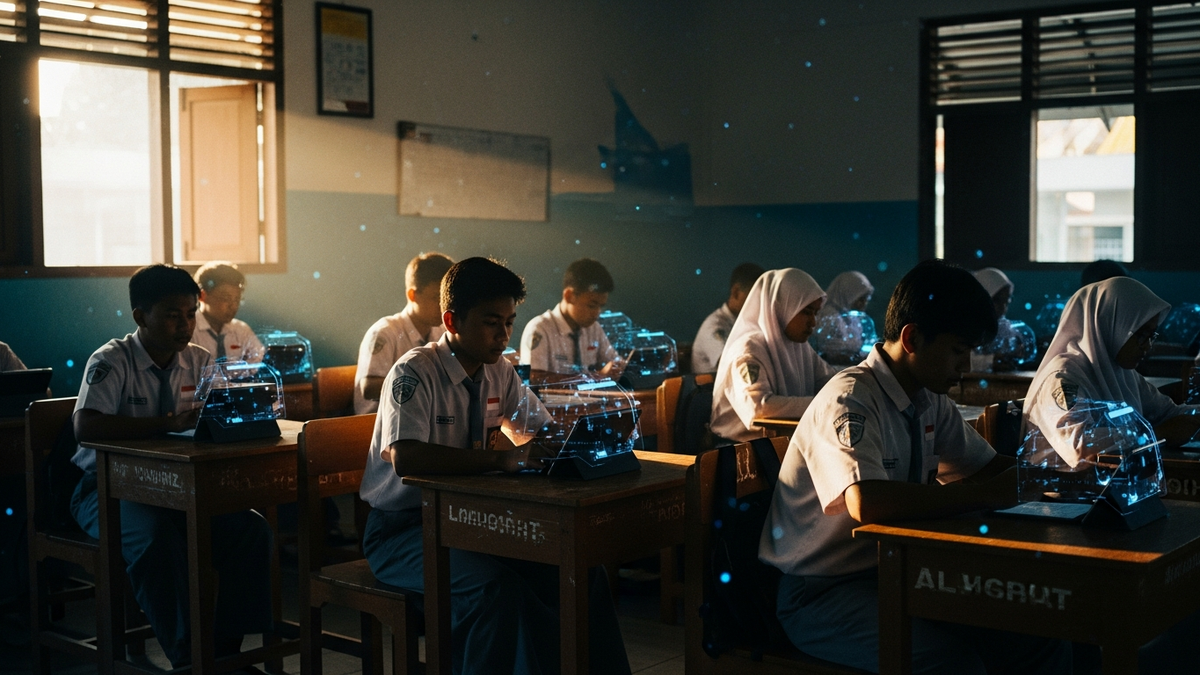
There is also a clear industrial logic. Embedding Sahabat AI in schools creates demand for domestic cloud capacity, Bahasa training data, and Indonesian AI educators. The curriculum is an AI-sector development policy dressed as an education reform, which is the only way it would have cleared inter-ministerial review this quickly.
Rollout Plan
| Phase | Timing | Scope | Focus | |---|---|---|---| | Phase 1 | School year 2026-2027 | 500 pilot schools, mainly Java, Bali, Sumatra | Teacher training, curriculum testing | | Phase 2 | School year 2027-2028 | All urban senior secondary nationally | Full subject integration | | Phase 3 | School year 2028-2029 | All primary and secondary schools | Offline delivery to remote islands | | Phase 4 | 2029 onward | Vocational schools, teacher colleges | Career pathways, AI specialisation |
Phase 1 is the hard part. Indonesia has the teacher capacity gap every large developing economy has, and rolling Sahabat AI into 500 schools means training heads of year, ICT teachers, and subject leads simultaneously. Ruangguru, Sekolah.mu, and the national teacher training college network are all being drafted in to support delivery, with funding from the ministry and matching contributions from domestic tech firms.
Our children should learn AI in Bahasa, with Indonesian examples, under Indonesian data protection. Sahabat AI makes that possible in a way no US model can.
This is the most ambitious AI-in-education programme in ASEAN. If Indonesia pulls it off, the rest of the region will copy within three years. For related context see our Singapore generative AI courses coverage.
Risks The Ministry Is Managing
The ministry has been unusually public about risks. The biggest is teacher capacity. A curriculum on paper is only as good as the teachers delivering it, and Indonesia's teacher workforce is uneven in digital fluency. The second risk is infrastructure. Not every Indonesian school has reliable connectivity, which is why offline-capable deployments of Sahabat AI, including cached prompts and local inference✦, are part of the plan.
There is also an academic integrity question. How does a Bahasa-heavy curriculum assess originality when students have sovereign AI✦ embedded into classroom workflows from year one? The ministry's answer is to reshape assessment itself, a philosophy closer to our recent Don't Be Lazy, Use Your Brain Instead of AI! piece than to detection-first schemes, with more oral explanation, in-class drafting, and AI-assisted work clearly labelled, rather than trying to police AI use.
- Design assessment to assume AI use, rather than to detect it.
- Invest in offline model caching for schools without stable internet connectivity.
- Run teacher training alongside, not after, student rollout.
- Publish Sahabat AI usage data back to schools in dashboards teachers can act on.
- Keep parents informed with clear, Bahasa-first explanations of data flow.
Frequently Asked Questions
What is Sahabat AI?
Sahabat AI is Indonesia's sovereign large language model, developed with Bahasa Indonesia and major regional dialects at its core. It is positioned as the default AI model for Indonesian public services and now for the national school curriculum from the 2026-2027 academic year onward.
Which students are included?
The curriculum covers upper primary through senior secondary pupils, which works out to more than 40 million Indonesian students in scope across the 2026-2029 rollout. Phase 1 will run initially through 500 pilot schools concentrated in Java, Bali, and Sumatra, with national scale expected by 2028.
How will teachers be trained?
Around three million teachers will receive mandatory AI literacy training. Training partners include Ruangguru, Sekolah.mu, national teacher training colleges, and ministry-accredited providers, funded by the ministry with matching contributions from domestic technology firms.
Is Sahabat AI used for grading?
Not primarily. The curriculum reshapes assessment around oral explanation, in-class drafting, and clearly labelled AI-assisted work, rather than relying on AI detection. Sahabat AI is positioned as a tool, not an assessor, with teacher judgment remaining central to summative assessment.
Can other ASEAN countries copy this?
Likely, yes. The Malaysian, Thai, and Vietnamese ministries are all watching the Indonesian rollout. The real precondition is a production-grade sovereign model in the local language, which only a few ASEAN countries currently have. Expect significant regional knowledge transfer over the next three years.
Can Indonesia actually deliver AI literacy at 40 million-student scale, and does a sovereign model give it a durable advantage? Drop your take in the comments below.






No comments yet. Be the first to share your thoughts!
Leave a Comment