
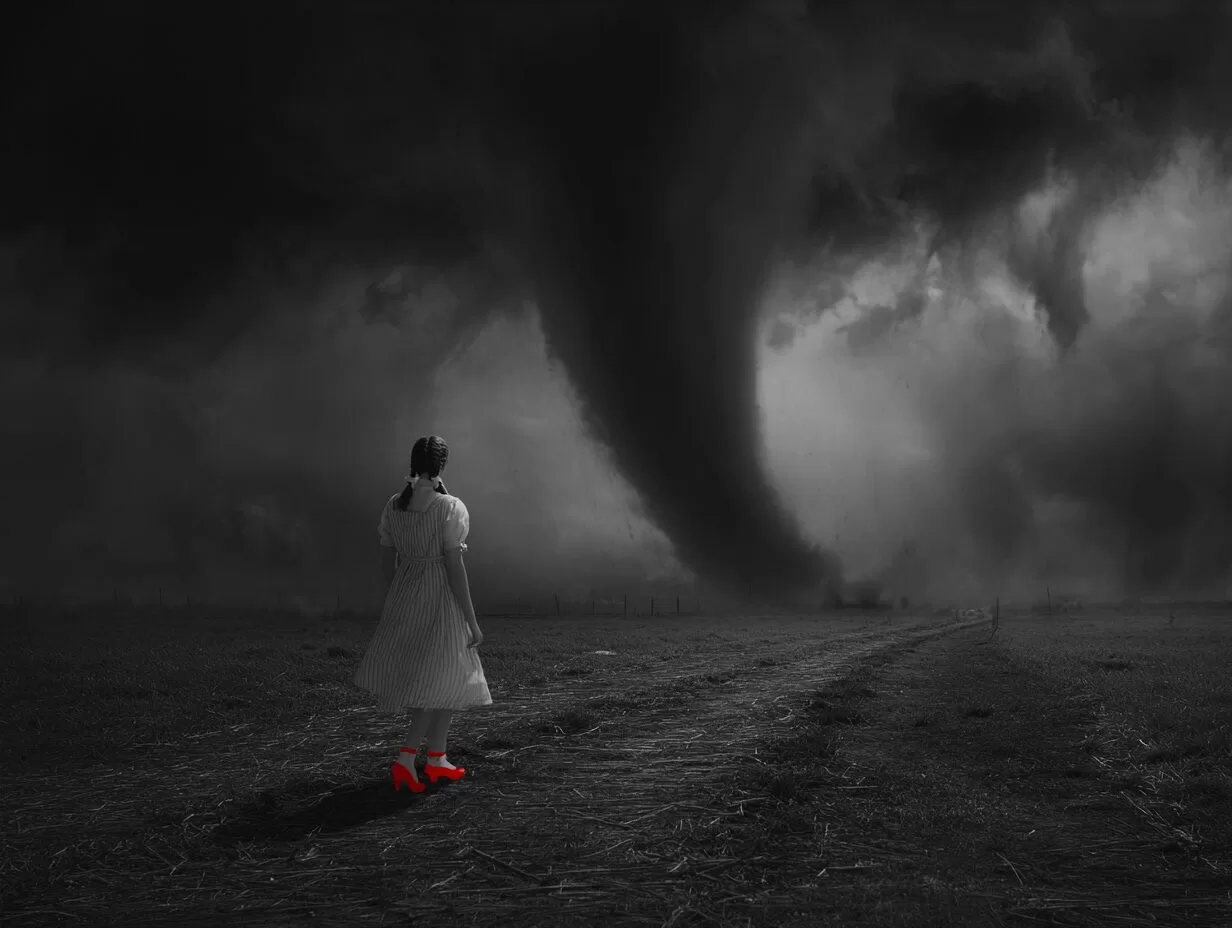
The beloved 1939 film has been reborn as a dazzling, AI-enhanced spectacle that places audiences inside Dorothy’s journey down the Yellow Brick Road.
Google AI and Warner Bros Discovery collaborated to reimagine The Wizard of Oz for the Las Vegas Sphere. The project involved more than 2,000 people and took two years to complete. AI enhanced the film’s original frames into ultra-high-definition while preserving authenticity.
A tornado like never before
When visitors step into the Sphere in Las Vegas, they are not merely watching The Wizard of Oz; they are living it. In the tornado scene, Dorothy’s farmhouse spins violently, with audiences encircled by a 160,000 sq ft LED screen towering 22 storeys high. Wind machines roar at 560 kilowatts, scattering debris as if the house itself might be lifted off its foundations.
It is the kind of spectacle MGM’s original filmmakers could scarcely have imagined.
An alliance of art and algorithm
The project represents one of the boldest unions of Hollywood and AI to date. Thao Nguyen, immersive arts agent at Creative Artists Agency, described it as “a meaningful milestone in AI-human creative collaboration,” one that could reset expectations of how culturally significant films are preserved and reimagined.
To achieve this, Warner Bros Discovery executives, Google’s DeepMind researchers, visual effects artists, and academics collaborated with Sphere Studios. More than 2,000 individuals contributed, all under the careful watch of studio lawyers who drew up guidelines for responsible AI use.
Some visual effects companies even declined involvement due to restrictions on AI at the time, a sign of the tensions that continue to surround machine learning in creative industries.
Preserving Dorothy without rewriting history
Ben Grossmann, who oversaw the visual effects, was acutely aware of the stakes. “If you touch anything about this sacred piece of cinema, you’re toast,” he remarked. AI was used as a last resort, chosen only when traditional CGI could not maintain the integrity of the performances. Generative AI models, trained specifically on actor likenesses, were developed in a tightly controlled environment. Warner Bros insisted that training data remain proprietary and never flow into Google’s public AI systems.
The results were striking. Judy Garland’s freckles, once softened by celluloid grain, are now visible in ultra-high-definition. The Scarecrow’s burlap weave appears almost tangible. Even incomplete shots—such as the Tin Man’s frantic axe swings—were “outpainted” to expand their cinematic impact.
Resurrecting the sound of Oz
The audio experience was equally ambitious. The original score was re-recorded on the very sound stage used in 1939, but this time with Sphere’s 167,000 speakers surrounding the audience. Judy Garland’s iconic vocals, however, remain untouched, preserving the emotional heart of the film.
Physical effects brought further immersion. Gigantic helium-filled monkeys swooped across the Sphere, manoeuvred by drone operators, as digital counterparts filled the skies onscreen.
A debate over authenticity
Not everyone has embraced this reimagining. Some cinephiles bristle at the idea of altering a film that has become part of cinema’s canon. Entertainment writer Joshua Rivera even called the production “an affront to art and nature.” For more on how AI can blur lines, read about AI Artists are Topping the Charts Weekly.
Jane Rosenthal, a long-time collaborator of Sphere Entertainment’s James Dolan, pushed back. “None of these people criticising this have seen the film or understand what we are doing,” she said. For her and the creative team, every change was in service of the audience’s perspective—to feel what Dorothy felt.
Why Oz was the right choice
Choosing The Wizard of Oz was no accident. Its original use of Technicolor—transitioning from sepia Kansas to the vivid Emerald City—was itself a groundbreaking moment in film. Sphere executives saw a symbolic continuity in reimagining a movie that had once set technical benchmarks.
Buzz Hays, head of Google Cloud’s entertainment industry group, described the project as a “first opportunity” to showcase how AI can expand rather than erase creativity. Hollywood, he quipped, always wants to be “the second” to adopt new technologies. This time, the Sphere forced it to go first. This sentiment echoes the broader discussion around the AI arms race and technology adoption.
The future of cinematic experience
The finished production is neither a simple film screening nor a VR simulation, but something in between—a hybrid of cinema, live theatre, and immersive experience. For audiences, it means stepping inside a world that has lived in popular imagination for nearly a century. Learn more about the potential of AI and nanoscience for future innovations.
As Grossmann noted, “We completed something filmmakers were intending to do but were limited by 1939’s tools.”
The question is whether this model—AI-enhanced reimaginings of classics—will become a new norm for studios seeking to reinvigorate old IP. If so, The Wizard of Oz at Sphere may well be remembered as the start of a new era in how we experience storytelling. For a deeper dive into the challenges and opportunities of AI in creative industries, you might explore this paper on AI and creativity from the World Intellectual Property Organization.

Latest Comments (3)
this part about visual effects companies declining involvement because of AI restrictions really resonates. we faced similar pushback trying to integrate AI for compliance checks in fintech here. everyone wants the efficiency but the legal and ethical frameworks aren't catching up fast enough. it's a constant battle explaining how AI is a tool, not a replacement, especially when the goal is preservation like they did for Dorothy. gotta find that sweet spot between innovation and trust.
the scale of this project, involving 2,000 people and two years, is immense. it makes me question the accessibility of such "AI-enhanced" cultural experiences for audiences outside of places like las vegas. is this the future we are building, where only a select few can afford these technologically advanced forms of entertainment?
this is exactly what I mean about AI and content! "preserving Dorothy without rewriting history" - yes! using AI to upscale original frames for an immersive experience like the Sphere without changing the core story is smart. imagine if we could do this for classic K-dramas, bringing them to new platforms with the same care. huge potential for preserving and expanding cultural reach.
Leave a Comment