

Korean Webtoon Studios Are Quietly Automating The Hardest Part Of The Craft
Naver Webtoon and Kakao Webtoon have spent 18 months integrating AI into what was, until recently, the most stubbornly manual part of Korean comics production: background art, panel transitions, and colour flatting. The public conversation has focused on AI character generation, which most studios have avoided for reputational reasons. The real shift is behind the scenes, and it is changing what a webtoon production team looks like.
Why Backgrounds, Not Characters
Character art carries author identity. A webtoon's face is its draftsman. Studios that replace characters with AI risk signalling to readers that the work is no longer authored. Backgrounds are different. They are repetitive, time-consuming, and do not contribute to reader attachment. A coffee shop rendered three times across ten chapters is not a branding problem if rendered by a well-trained model and polished by a human assistant.
That economic logic drove a wave of pilots in 2024. By late 2025, the flagship studios had integrated background pipelines with tools like Stable Diffusion XL fine-tunes on Korean urban photography, Ideogram for architecturally consistent settings, and proprietary models trained on studio-owned back catalogues. Public reaction has been muted because readers mostly did not notice.
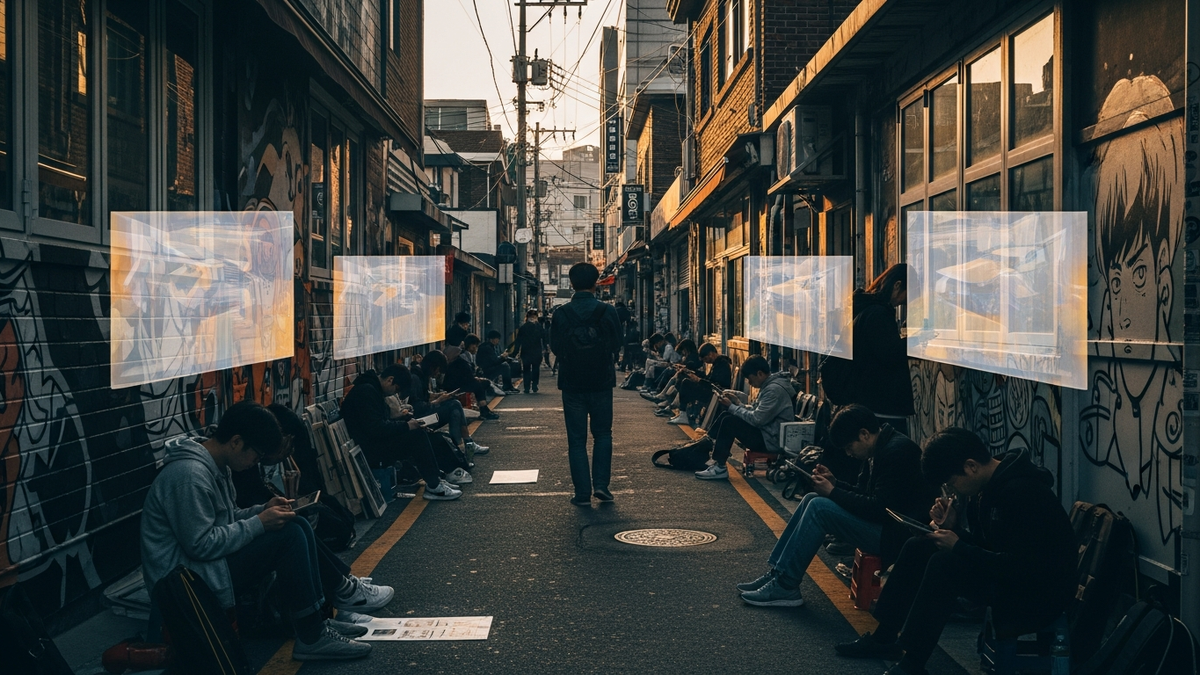
The Workflow That Replaced Six Studio Assistants
A typical flagship webtoon chapter in 2023 required four assistants: one for backgrounds, one for flatting, one for rendering effects, and one for lettering. By 2026, AI has collapsed the first three roles into a single hybrid workflow where one senior assistant supervises AI output and makes final corrections. Lettering remains human because Korean typography carries mood.
We do not call this AI automation, we call it pipeline acceleration. The output quality is the same as three years ago, but our weekly deadline anxiety is down 40%.
By The Numbers
- Naver Webtoon and Kakao Webtoon combined serve more than 80 million monthly active users globally.
- Average webtoon production team size dropped from 6 to 3 senior roles plus AI-assisted workflow.
- TAIDE in Taiwan is building a parallel Traditional Chinese creator ecosystem✦.
- Background rendering time per chapter reduced from 8 hours to 90 minutes for medium-density scenes.
- AI background detection tools from Naver Labs correctly identified AI output 82% of the time in blind tests.
The Creator Economy Response
Freelance assistants who specialised in backgrounds have been hit hardest. Some have retrained into AI supervision roles, others into lettering or storyboarding. Studios report a bifurcation: junior creators struggle to get apprenticeship footholds because the role that used to train them no longer exists at scale✦, while senior artists increase their output by 30 to 50% and see income rise accordingly.
Union and creator groups have pushed for disclosure. As of 2026, Naver and Kakao both include AI-assistance tags in metadata, though visibility to readers varies. Korean Creative Content Agency (KOCCA) has issued voluntary guidelines that the industry is slowly adopting.
| Role | 2023 Status | 2026 Status |
|---|---|---|
| Lead artist | Core role | Core role, higher output |
| Background assistant | Entry role | Largely consolidated into AI workflow |
| Flat colourist | Entry role | AI-first, human supervision |
| Effects renderer | Specialist role | Hybrid with AI |
| Letterer | Specialist role | Still fully human |
| Storyboarder | Senior role | Growing demand |
Beyond Korea
Naver and Kakao both sell their workflows as products to regional studios. Indonesian and Thai comics publishers have licensed background AI tools. Taiwan's TAIDE-based ecosystem is building adjacent capabilities for Traditional Chinese language comics and novels. Japanese publishers, notably Kodansha and Shueisha, have watched carefully but moved slower because Japanese manga culture still carries stronger expectations of human-only authorship.
We shipped seven weekly series last year with AI backgrounds. Not one reader complaint in the comment threads. The audience does not care, provided the work retains its voice.
What Creators Should Know
- If you draw commercially in Asia, learn the AI supervision role. Studios need it.
- Keep a distinct visual signature for your character work. That is your moat✦.
- Do not try to hide AI backgrounds in 2026 production. Disclosure is becoming policy.
- Invest in storyboarding and scripting skills. Those are human-premium.
- Consider regional markets outside Korea and Japan. Indonesian and Thai webcomics are growing fast.
Frequently Asked Questions
Which webtoon platforms use AI the most aggressively?
Naver Webtoon and Kakao Webtoon lead globally. Lezhin and Bomtoon use AI selectively. Emerging platforms in Thailand and Indonesia have been faster to adopt because production teams are smaller.
Are AI character illustrations common?
No. Studios overwhelmingly keep character work human to preserve author identity and reader trust. AI character generation is used mainly for rough sketches, not final art.
What happened to entry-level assistant jobs?
They contracted sharply. Junior roles have partly shifted into AI supervision, storyboarding, and lettering, but the overall entry pipeline is narrower than three years ago.
Can AI backgrounds be detected?
Imperfectly. Naver Labs detection tools reach around 82% accuracy in blind tests. Casual readers almost never notice.
Does this apply to Japanese manga?
Partially. Japanese publishers have been slower to adopt due to cultural expectations of human authorship. Small publishers experiment more than the big two. Kodansha and Shueisha remain cautious.
Do you think AI in webtoon production will creep from backgrounds to character art over the next two years, or will studios hold the line? Drop your take in the comments below.






No comments yet. Be the first to share your thoughts!
Leave a Comment