

From Selling Specs to Selling Agents: Inside the Huawei-Xiaomi AI Sovereignty Battle
By The Numbers
- 900 million: Active devices running HarmonyOS by late 2025
- Over 90%: Huawei devices running homegrown HarmonyOS as of January 2026
- March 19 and March 23: Xiaomi and Huawei press conference dates in 2026
- Two competing visions: AI agent dominance across Chinese tech ecosystems
- 5+ years: Development behind Huawei's independent microkernel OS architecture
The smartphone wars have evolved. What began as a race for processor cores and megapixels has transformed into something far more consequential: control over the AI agent that mediates your entire digital existence. In March 2026, Huawei and Xiaomi unveiled fundamentally different answers to the same question: who should own the intelligence layer between you and your devices?
This is where the real battle lies. Not in hardware specifications, but in sovereignty itself.
The Sovereignty Split: Physical vs. Logical Control
When Huawei unveiled HarmonyOS 6 on March 23, it presented a vision of what Chen Hao, speaking for the company, described as advancing "its All Intelligence strategy, moving toward all-scenario intelligence." But beneath that phrase lies a radical commitment: total ecosystem✦ independence from Western technology foundations.
Huawei's approach is structural. The company has developed its own chips, built a microkernel operating system, and created proprietary AI frameworks. This is what executives call "root sovereignty", meaning independence at the physical level. HarmonyOS 6 positions itself as "a second digital survival system" entirely detached from Android, iOS, or any infrastructure controlled by US-aligned technology companies. As positioning statements go, it's unambiguous: we do not depend on outsiders.
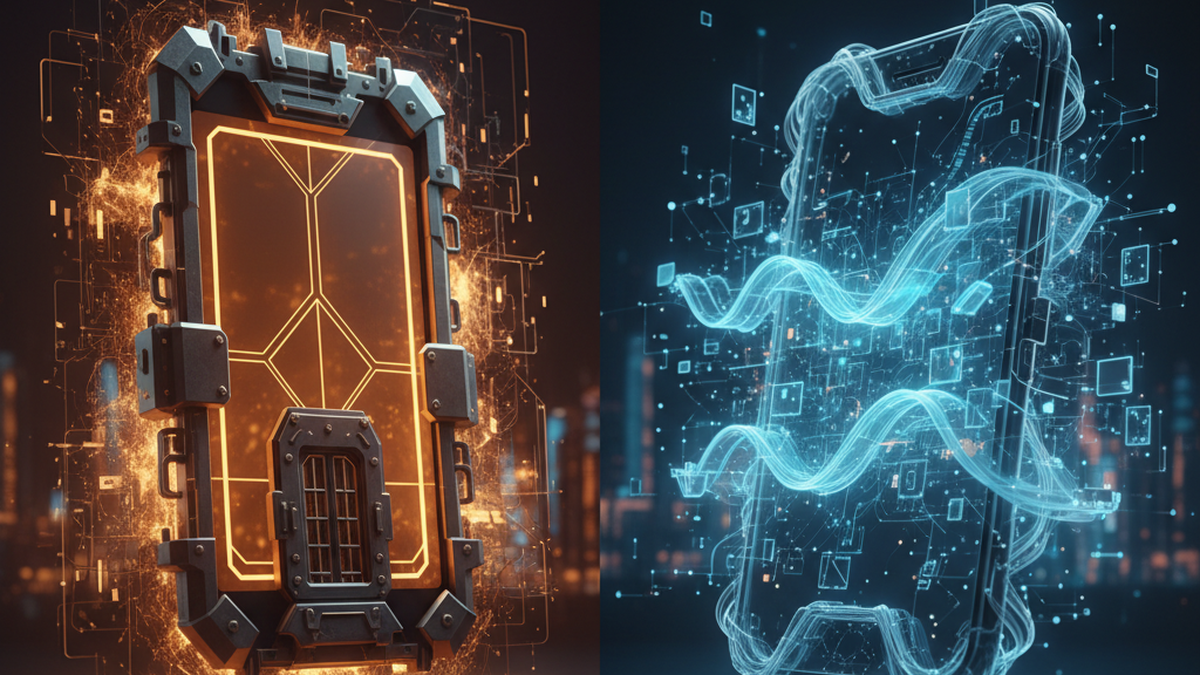
Xiaomi, by contrast, took the stage on March 19 with a different philosophy. Rather than seeking independence through complete stack control, Xiaomi announced MiMo, a large language model designed to operate as what company leadership frames as a "logical centre." This centre integrates third-party services across devices, including iOS devices. The strategy is distributive rather than isolationist. Xiaomi positions itself as an efficient scheduler and traffic manager, the orchestrator of a more open ecosystem where it captures value through arrangement rather than exclusion.
| Dimension | Huawei | Xiaomi |
|---|---|---|
| OS Independence | Proprietary microkernel | Integrated third-party services |
| AI Architecture | Homegrown frameworks | MiMo large language model |
| Ecosystem Model | Closed and sovereign | Open and orchestrated |
| Device Scope | HarmonyOS devices only | Cross-platform (including iOS) |
| Strategic Focus | Physical-level control | Logical-level convenience |
These are not minor product differentiations. They represent two competing visions for the future of AI in Asia.
Why Agents Matter More Than Specs
Ten years ago, smartphone vendors competed on clock speeds and camera sensors. Five years ago, they fought over 5G connectivity. Today's competition is about something more fundamental: who owns the agent that decides which services you use, in what order, and under what conditions?
An AI agent in this context is not simply a chatbot. It is a decision-making layer that understands your intent and routes you through the digital landscape. It learns your preferences, predicts your needs, and, crucially, it chooses which company's services you access first, most often, and most deeply.
Huawei's strategy recognizes that true sovereignty requires controlling this layer entirely. By ensuring HarmonyOS runs on over 90% of its own devices and maintaining 900 million active users, the company creates a closed loop where the AI agent answers only to Huawei's logic, not to external pressures. The company has partnered with China Unicom on AI Reshaping Co-Creation initiatives that extend this control into smart homes, network management, and agent deployment across institutional clients.
Xiaomi's strategy recognises that breadth may trump depth. If MiMo can efficiently schedule services across both its own devices and competitors' platforms, it becomes indispensable not through exclusion but through convenience. Xiaomi positions itself as the "expanding territory, breadth of convenience" alternative to Huawei's "pillar of stability, bottom line of independence."
The shift from hardware competition to agent competition is not a marketing evolution. It is a fundamental restructuring of how digital power flows in Asia.
The Geopolitical Subtext
This would be a straightforward competitive battle if geopolitics were not involved. But US lawmakers, alarmed by HarmonyOS expansion, have begun urging allies to block its international rollout. The concern is explicit: a Chinese-controlled operating system mediating AI agent decisions represents a loss of technological influence.
Huawei's response is to frame sovereignty not as hostility but as necessity. The company's messaging positions HarmonyOS as the foundation of "Defined in China", a shift from the older framing of "Made in China." This is rhetorical but also structural. Defined in China means that the rules, standards, and priorities embedded in the AI agent reflect Chinese values and Chinese interests, not Western assumptions.
Xiaomi's approach is subtler. By remaining interoperable with iOS and by framing MiMo as a service layer rather than a platform layer, Xiaomi maintains diplomatic flexibility. It can expand into global markets without triggering the same national security concerns. It sacrifices the controlled autonomy that Huawei seeks in exchange for broader reach.
Huawei will advance its All Intelligence strategy, moving toward all-scenario intelligence. The foundation is complete independence at every layer of the stack.
What This Means for the Broader Market
The Southeast Asia enterprise AI adoption landscape is already shifting in response to these competing visions. Enterprises in Singapore, Vietnam, and Indonesia are making choices about which ecosystem to bet on. Those choices have compounding effects.
Huawei's approach offers security through independence. Organisations that adopt HarmonyOS devices and services gain a measure of autonomy from global technology supply chains. This appeals to governments, state enterprises, and large corporations concerned about economic dependence. The US-Taiwan semiconductor deal underscored how precarious these dependencies can become.
Xiaomi's approach offers flexibility and reach. Organisations that adopt MiMo can maintain existing infrastructure whilst gaining AI agent capabilities. This appeals to companies already invested in mixed ecosystems, and to countries pursuing pragmatic rather than ideological technology strategies.
For creators and service providers, the implications are equally significant. The Sora shutdown and Asian AI creators moment demonstrated how quickly AI infrastructure decisions can affect entire creative communities. The Huawei-Xiaomi split means creators must now consider not just which platform reaches the most users, but which agent architecture will determine how their content is discovered and promoted.
The Real Competition
The hardware specs that once dominated trade publications are now footnotes. The real competition is over the agent, the intelligence layer that mediates every digital interaction. Huawei is betting on sovereignty through complete control. Xiaomi is betting on dominance through orchestration. Both strategies are rational. Both could succeed.
Events like GITEX AI Asia 2026 and growing on-device AI hardware initiatives across the region indicate that this competition will intensify. The stakes are not about quarterly sales figures or market share points. The stakes are about which company's logic will shape how billions of people interact with technology, make decisions, and access information.
China's AI trajectory, from laboratory research to factory-scale deployment; is accelerating precisely because companies like Huawei and Xiaomi are no longer just selling devices. They are selling the intelligence systems that define what those devices can do.
Singapore's AI adoption leadership at the per-capita level suggests that whichever AI agent architecture proves most efficient and most trustworthy will rapidly consolidate market position. There is no third place in agent dominance. You either control the logic, orchestrate the services, or you become irrelevant.
Frequently Asked Questions
What is the difference between Huawei's sovereignty approach and Xiaomi's integration approach?
Huawei builds everything in-house, including operating system, chips, and AI frameworks, creating a closed system independent of external technology. Xiaomi develops MiMo to work across devices and platforms, focusing on being the efficient coordinator of services rather than the sole provider.
How does HarmonyOS achieve "root sovereignty"?
HarmonyOS runs on proprietary microkernel architecture, Huawei-designed chips, and Huawei AI frameworks. Over 90% of Huawei devices use this homegrown system, creating a setup with no dependence on Android, iOS, or US-controlled technology stacks.
Why would companies choose Xiaomi's approach over Huawei's?
Xiaomi's approach offers flexibility, interoperability with existing infrastructure, and broader market reach without the geopolitical tensions that Huawei faces. For organisations with mixed technology setups, this can be more pragmatic.
Is this competition only relevant to China?
No. These competing agent architectures will shape how AI services are delivered across Asia and eventually globally. The companies winning this battle will determine infrastructure standards and user behaviours for billions of people.
How do geopolitical concerns affect these strategies?
US policy makers view HarmonyOS expansion as a threat to Western technological influence. This drives Huawei toward deeper sovereignty claims and more complete control, whilst Xiaomi's interoperable approach faces fewer international restrictions.
This is no longer about who builds faster chips or better cameras. Drop your take in the comments below. Which vision for AI agent architecture do you think will dominate Asia's digital landscape?






No comments yet. Be the first to share your thoughts!
Leave a Comment