

Singapore Rolls Out the Red Carpet for Asia's Biggest AI Dealmaking Event
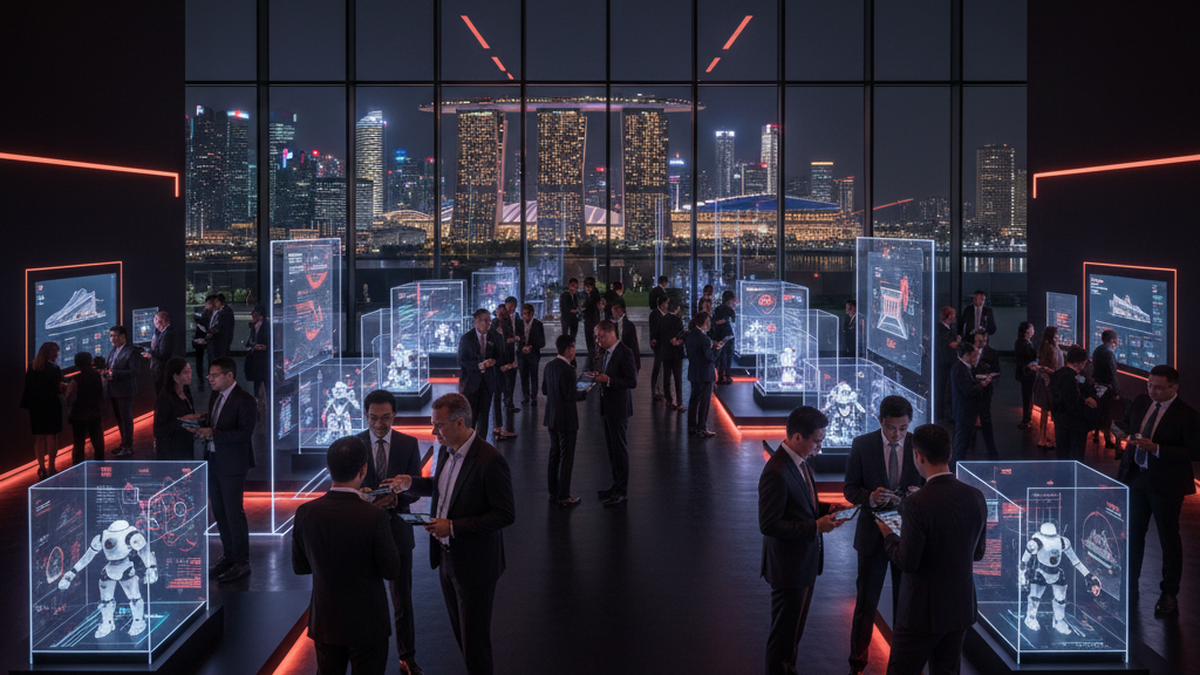
April in Singapore means more than Marina Bay's monsoon rains. It signals the arrival of GITEX AI Asia 2026, the region's flagship gathering for artificial intelligence investment, innovation, and policy. Scheduled for 9-10 April at Marina Bay Sands, the event arrives at a crucial moment: Asia-Pacific AI spending is accelerating, Southeast Asia's startup funding has surged 217%, and governments across the region are moving from enthusiasm to concrete deployment.
The numbers alone tell a story of scale. Over 23,000 technology executives from 110 countries will convene around 750 enterprises and startups, with 250 investors and venture capitalists managing US$350 billion in combined assets. This is not merely a conference. It is a marketplace where the region's AI future gets negotiated in real time.
Why Singapore, Why Now
Singapore has positioned itself as Asia's AI capital with tangible commitment. The government has pledged over S$1 billion (US$778.8 million) to public AI research, creating infrastructure and talent pipelines that rival global hubs. The city-state consistently ranks at the top for per-capita AI adoption across the continent, and that lead is widening.
The timing also matters. Southeast Asia's startup scene has undergone a sharp recovery after the 2023-24 funding slowdown. Companies like Thailand's Amity, which recently secured US$100 million in funding for generative AI✦ applications, demonstrate that Southeast Asian founders are no longer chasing trends. They are creating them.
GITEX AI Asia has become an important gathering point for technology leaders from around the world. It is a pivotal platform supporting the AI momentum in Asia.
Meanwhile, cybersecurity threats have become impossible to ignore. Asia's estimated cybercrime costs now reach US$1.2 trillion annually, a figure that drives parallel urgency in enterprise AI security spending. GITEX's co-location of GISEC Asia, the region's largest cybersecurity conference, reflects this reality: AI and security are now inseparable concerns for corporate buyers.
By The Numbers
- 23,000+: Technology executives attending from 110 countries
- US$350 billion: Combined assets under management among the 250+ attending investors and VCs
- 750+: Enterprises and startups exhibiting at Marina Bay Sands
- SGD 100,000+: Prize pool for the Supernova Challenge, with 50 shortlisted startups competing
- 39-46%: Compound annual growth rate for Asia-Pacific AI spending through 2032
The Four-in-One Event Model
GITEX AI Asia does not exist in isolation. The event co-locates four specialised conferences under one roof:
- AI Everything Singapore: The main AI innovation showcase covering enterprise deployment across retail, fintech, manufacturing, medical, and automotive sectors
- GISEC Asia: The region's largest cybersecurity event, addressing threats to data centres, banks, and supply chains
- GITEX Quantum Expo Asia: Quantum computing hardware, AI integration, and industry applications
- GITEX Digi_Health and Biotech Singapore: AI in healthcare, diagnostics, and biotechnology innovation
Country pavilions from Australia, China, Germany, India, South Korea, and Singapore will showcase regional strengths. New pavilions from Belgium, Canada, and the Philippines mark the event's expanding geographic reach. The Supernova Challenge, where 50 shortlisted startups compete for prizes exceeding SGD 100,000, serves a crucial function: early-stage founders gain exposure to institutional investors, corporates scout acquisition targets, and the region identifies which sub-sectors are closest to product-market fit✦.
Speakers and Strategic Priorities
The confirmed speaker roster reveals what Asian leaders consider urgent. Dr Cathy Foley, former Chief Scientist of Australia, brings perspective on bridging research and commercialisation. Shunsuke Okada, Chief Digital Officer of Toshiba, represents manufacturing's pivot✦ toward AI-driven✦ operations. Pedro-Uria Recio, Chief Data and AI Officer at CIMB, speaks to financial services across Southeast Asia.
The quantum computing delegation, including José Ignacio Latorre (Director, Centre for Quantum Technologies at NUS Singapore) and Joe Fitzsimons (Founder and CEO, Horizon Quantum), signals that the region is not just adopting existing AI tools. Governments and enterprises are investing in the next layer of computational capacity.
We showcased startups for the first time in this new and growing market, which is a huge opportunity for our companies.
Enterprise Momentum Across the Region
Southeast Asia's enterprises are outrunning the world on AI adoption, according to recent McKinsey and EDB research. Rather than waiting for perfect solutions, companies are launching pilots, iterating on results, and scaling what works. This pragmatism, born partly from constrained IT budgets, is creating a competitive advantage.
Recent movers underline this shift. FPT's IvyChat, a Vietnamese agentic✦ AI platform, won a global award for innovation. Vietnam is drafting the first comprehensive AI legislation in Southeast Asia, signalling regulatory maturity. China's industrial AI push is accelerating as factories adopt intelligent automation. These are not isolated incidents but symptoms of a region gaining confidence in its AI capabilities.
| Event Component | Focus | Key Metric |
|---|---|---|
| AI Everything Singapore | Enterprise AI deployment | 170+ speakers, 60+ hours |
| GISEC Asia | Cybersecurity | US$1.2T annual cybercrime costs in Asia |
| GITEX Quantum Expo Asia | Quantum computing | Cloud-based hardware, AI integration |
| GITEX Digi_Health | Healthcare AI | Diagnostics, biotech innovation |
| Supernova Challenge | Startup competition | 50 startups, SGD 100K+ prizes |
Frequently Asked Questions
Who should attend GITEX AI Asia 2026?
Enterprise technology leaders, venture capitalists, government officials overseeing AI policy, startup founders seeking investment, and corporate development teams evaluating partnerships. The speaker lineup and attendee mix reflect three primary audiences: those building AI products, those buying AI solutions, and those investing in or regulating both.
What is the difference between GITEX AI Asia and the broader GITEX event?
GITEX AI Asia is the regional AI-focused edition, held in partnership with Singapore's government and EDB. It co-locates complementary events covering cybersecurity, quantum computing, and digital health. The broader GITEX event, held annually in Dubai, is larger but less regionally specialised for Asia-Pacific markets.
Why is Singapore the host city rather than another Asian hub?
Singapore combines three factors: regulatory clarity around AI, substantial government investment in research infrastructure (over S$1 billion committed), and established status as a financial hub where venture capital and corporate headquarters concentrate. The city-state's positioning also makes it acceptable as a venue for participants from competing economies.
What should investors monitor at the event?
Key indicators include which Southeast Asian sub-sectors attract the most investor attention, including fintech AI, manufacturing optimisation, and healthcare diagnostics. The Supernova Challenge results and investor panels will signal capital allocation priorities for the coming 12 months.
How can startups participate in the Supernova Challenge?
Fifty startups have been shortlisted across AI, climate tech, fintech, and advanced technology categories. Winners receive prizes exceeding SGD 100,000, plus direct exposure to 250 investors managing US$350 billion in combined assets. Registration details are available on the official GITEX AI Asia website.
For technology leaders across the region, GITEX AI Asia 2026 represents more than a calendar event. It is evidence that Asia's AI transition, from experimentation to operational deployment, is now real, measurable, and investable. Drop your take in the comments below.