

Wind Turbines With Server Rooms in Their Legs
The AI industry's energy problem is no longer theoretical. Data centres already consume roughly 2% of global electricity, and that figure is climbing fast as models grow larger and inference✦ demand multiplies. The standard playbook, building ever-bigger facilities on cheap land near power grids, is running into hard limits: grid capacity, water scarcity, and communities that simply do not want a humming warehouse next door.
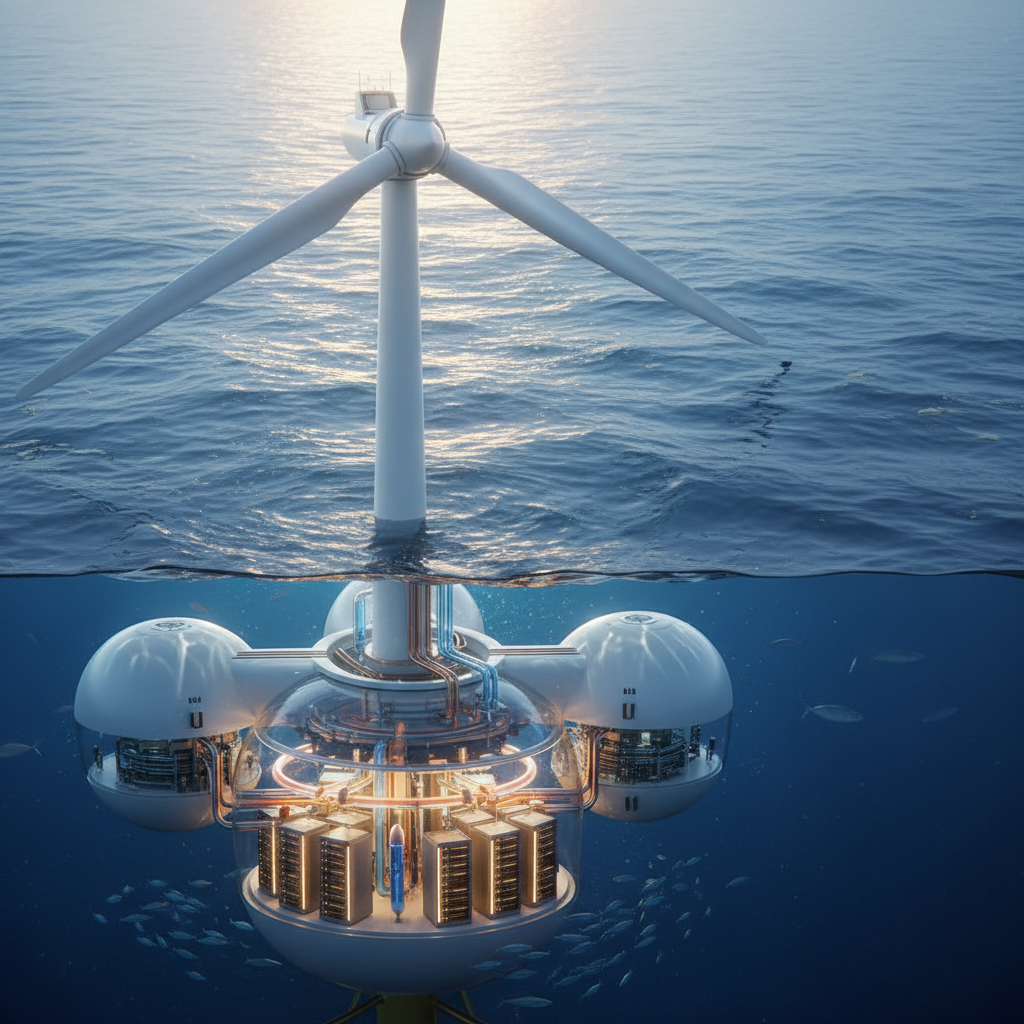
Aikido Technologies, a San Francisco startup, is proposing something genuinely different. Rather than fighting for grid access onshore, the company wants to put AI data centres inside the ballast tanks of floating offshore wind turbines, powered directly by the turbine above them and cooled by the ocean around them.
It sounds like science fiction. But the engineering is grounded in decades of offshore oil and gas platform design, and the first prototype is already headed for the water.
How a Floating Data Centre Actually Works
Aikido's platform uses semisubmersible technology borrowed from the oil and gas sector. A single wind turbine sits at the centre of a structure roughly the size of a football pitch, supported by three legs that extend outward into ballast tanks. Those tanks, traditionally filled with freshwater for buoyancy, double as server halls in Aikido's design.
Each ballast tank can house a 3 to 4 megawatt data hall, giving a single platform a combined 10 to 12 MW of compute✦ capacity. The freshwater inside the tanks is chilled naturally by the surrounding ocean and circulated through the servers as liquid coolant. Warmed water cycles back into the ballast for re-cooling, creating a closed loop that eliminates the need for massive external cooling infrastructure.
"We have this power from the wind. We have free cooling. We think we can be quite cost competitive compared to conventional data-center solutions." - Sam Kanner, CEO, Aikido Technologies
Onboard batteries and a grid connection provide backup for periods when wind drops. The design is modular, what Kanner calls an "IKEA-like" assembly approach, meaning platforms can be manufactured onshore and towed into position.
By The Numbers
- 10-12 MW: Total compute capacity per floating platform, split across three ballast-tank server halls
- 100 kW: Capacity of Aikido's pilot prototype, scheduled for North Sea deployment off Norway by end of 2026
- 2%: Share of global electricity consumption attributed to data centres, projected to rise to 3-4% by 2030
- $3.9 billion: Recent investment in Singapore's data centre expansion by Bridge Data Centres, illustrating the scale of Asia-Pacific demand
- 70%: Proportion of a typical data centre's non-IT energy budget spent on cooling systems
Why Asia-Pacific Should Be Watching
The floating data centre concept is being piloted in the North Sea, but its most compelling use case may be closer to the equator. Singapore, the region's dominant data centre hub, imposed a moratorium on new facilities from 2019 to 2022 due to energy and land constraints. Even after lifting it, the city-state now mandates that new data centres meet strict sustainability standards that have slowed approvals.
Across Southeast Asia, the bottleneck is consistent: countries want AI infrastructure but lack the grid capacity, water resources, or land to host conventional data centres at scale✦. Offshore platforms sidestep all three constraints. They consume no land, generate their own power, and use ocean water for cooling.
"A lot of energy in the clean-energy space is focused on powering AI data centers quickly, reliably, and cleanly in a way that does not upset neighbors and remains safe, fast, and cheap." - Ramez Naam, Independent Clean Energy Investor
Japan and South Korea, both investing heavily in sovereign AI infrastructure, face similar pressures. Japan's northern coastline and South Korea's offshore wind ambitions could make floating data centres a natural fit, particularly for latency-tolerant workloads like model training and batch inference.
| Factor | Onshore Data Centre | Floating Offshore Data Centre |
|---|---|---|
| Power source | Grid (often fossil-heavy) | Integrated wind turbine + grid backup |
| Cooling | Chillers, evaporative (high water use) | Ocean-cooled closed loop (zero freshwater draw) |
| Land required | Significant (industrial zoning) | None (offshore lease) |
| NIMBY risk | High (noise, traffic, visual) | Low (out of sight) |
| Construction time | 18-36 months typical | Modular, potentially faster at scale |
| Security risk | Physical access, cyberattack | Subsea cable sabotage, maritime threats |
| Regulatory maturity | Well-established | Largely uncharted |
The Engineering Risks Nobody Is Glossing Over
Putting servers in the ocean introduces problems that onshore facilities never face. Saltwater corrosion, marine debris, and the constant mechanical stress of wave motion are all threats to uptime. Aikido's closed-loop freshwater system isolates the servers from direct seawater contact, but Daniel King, a research fellow specialising in AI infrastructure, calls the approach "a novel one" that still needs long-term validation.
Liquid cooling handles the GPUs and CPUs, but not every component plays along. Ethernet switches and other networking gear still require traditional air conditioning, which adds complexity inside a sealed marine environment. The mixed cooling architecture is one of the harder engineering challenges Aikido faces.
Then there is security. Offshore infrastructure in the North Sea has come under increased scrutiny following reports of Russian vessels interfering with subsea cables and wind farms. Kanner suggests reliance on national coast guards, but protecting remote, critical computing infrastructure in open water is a fundamentally different problem from securing a fenced facility in an industrial park.
Regulation is the wildcard. Offshore data centres do not fit neatly into existing permitting frameworks. Environmental reviews for heat discharge, electromagnetic interference, and marine ecosystem✦ impact could prove more onerous than standard onshore approvals. "It's unclear to me whether this actually makes life easier or harder for a developer," King notes.
From Crypto Rigs to AI Racks
Aikido's origin story predates the generative AI✦ wave. Kanner originally explored powering cryptocurrency mining rigs with offshore wind, a concept that gained little traction when crypto prices were low. The arrival of ChatGPT in late 2022, and the subsequent explosion in demand for GPU✦ compute, gave the idea a far more compelling economic case.
The timing aligns with a broader industry shift. Asia's memory chip manufacturers are racing to meet AI hardware demand, and the infrastructure to house and power that hardware is struggling to keep pace. Conventional data centre capacity in key Asian markets is being snapped up faster than it can be built, with Singapore, Tokyo, and Mumbai all reporting record-low vacancy rates.
Aikido's 100-kilowatt prototype, heading for Norwegian waters by the end of 2026, is a proof of concept rather than a commercial deployment. But the underlying logic, co-locating compute with its own power source rather than competing for grid access, resonates with the constraints facing Asia-Pacific's semiconductor and AI infrastructure buildout.
Can floating data centres match the uptime of onshore facilities?
That remains unproven. Aikido's design includes battery backup and grid connection for redundancy, but the marine environment introduces failure modes, such as storm damage and cable faults, that onshore facilities rarely face. The pilot deployment will be the first real test of sustained uptime at sea.
Would floating data centres work in tropical waters like Southeast Asia?
Warmer ocean temperatures reduce cooling efficiency compared to the North Sea. However, deep-water intake could still provide adequate cooling, and the stronger, more consistent winds in some tropical offshore zones could offset the thermal disadvantage. It is technically feasible but would require design adaptation.
How does the cost compare to a traditional data centre?
Aikido claims cost competitiveness through free power and cooling, but construction and maintenance costs for offshore platforms are significantly higher than onshore buildings. The economics depend heavily on scale: a single platform is expensive, but a fleet sharing manufacturing and logistics infrastructure could shift the equation.
What happens to the servers if a platform needs emergency maintenance?
The modular design allows platforms to be towed to port for major repairs. For routine maintenance, Aikido envisions crew boats and helicopter access similar to existing offshore wind farm operations. Remote monitoring and automated failover to other platforms in a network would manage compute continuity.
Offshore wind has already proved it can power millions of homes. The question now is whether it can power the AI models that are reshaping those homes, workplaces, and economies. If Aikido's North Sea prototype holds up, the implications for energy-constrained markets across Asia could be significant. Would you trust your AI workloads to a server room bobbing in the ocean? Drop your take in the comments below.






No comments yet. Be the first to share your thoughts!
Leave a Comment