

Saudi Arabia's "Year of AI": Inside the Kingdom's $20 Billion Bet
When Saudi Arabia's Cabinet formally designated 2026 as the "Year of Artificial Intelligence," it was not making a symbolic gesture. It was putting a price tag on an ambition. Across a 12-month stretch that has already seen $9.1 billion in AI funding deals, a $2.7 billion data centre breaking ground, and a $3 billion stake in Elon Musk's xAI, the Kingdom is executing the most aggressive state-backed AI investment programme outside the United States and China.
The architect of this push is HUMAIN, a company launched in May 2025 and wholly owned by the Public Investment Fund (PIF), Saudi Arabia's $930 billion sovereign wealth vehicle. HUMAIN is not a research lab or a think tank. It is a deal machine, and the deals are stacking up fast. The scale of capital being deployed dwarfs anything in the broader Asian AI investment landscape, where even record-breaking quarters cannot match the velocity of a single sovereign fund writing cheques.
By The Numbers
- $9.1 billion in AI funding deals closed in Saudi Arabia in 2025 across 70 transactions
- $23 billion in strategic technology partnerships announced by HUMAIN
- $10 billion AI venture fund launched by HUMAIN for global tech investments
- 664 companies now operating in Saudi Arabia's data and AI sector
- 480 megawatts of capacity planned for the Hexagon data centre, the world's largest government facility
- $3 billion invested in xAI's Series E round, making HUMAIN a significant minority shareholder
- $2.7 billion committed to the Hexagon data centre project in Riyadh
The Hexagon: Building the World's Largest Government Data Centre
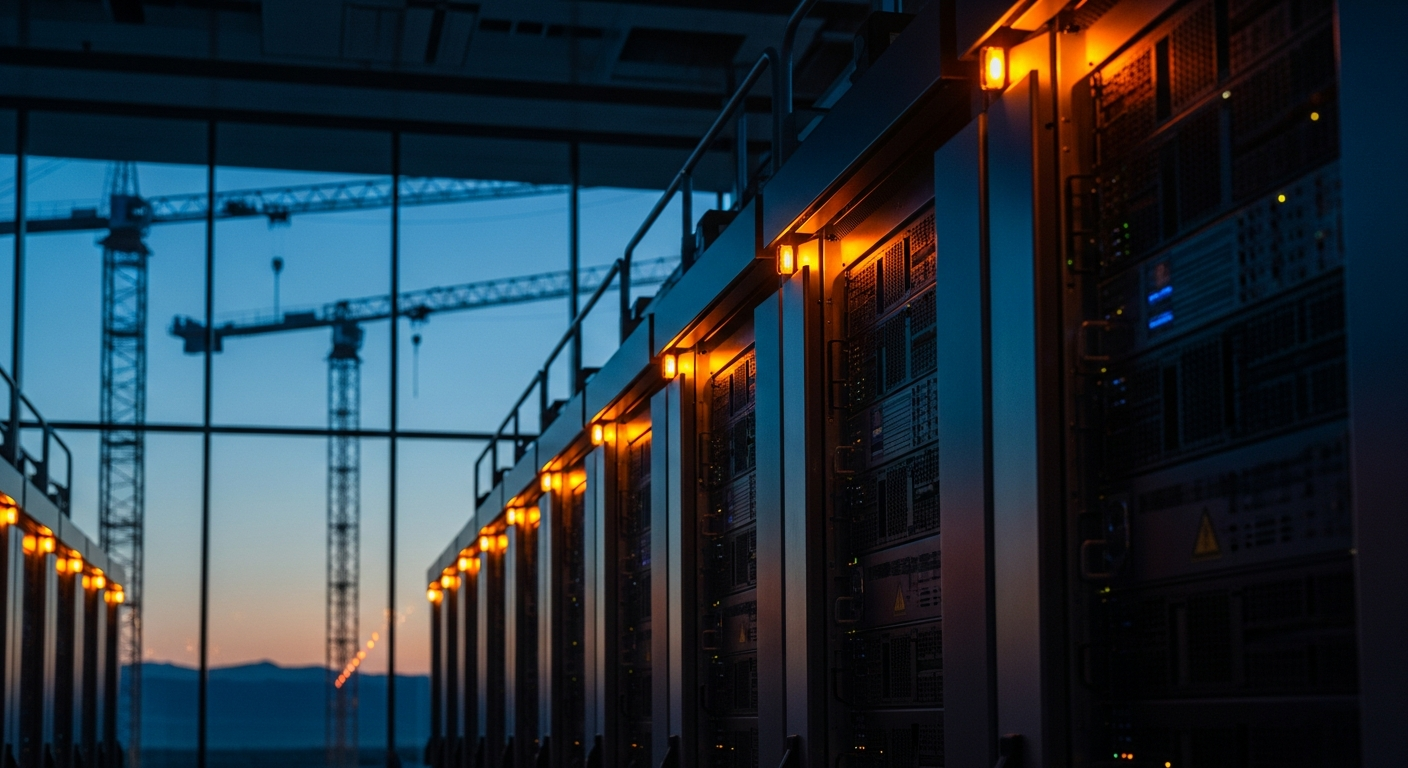
The centrepiece of Saudi Arabia's infrastructure play broke ground in January 2026. The Hexagon data centre, under construction in Riyadh, will be a Tier IV-rated facility spanning 30 million square feet with 480 megawatts of capacity. At completion, it will be the largest government-owned data centre on the planet.
The $2.7 billion price tag covers only the first phase. HUMAIN's broader infrastructure roadmap calls for 50 megawatts of new capacity every quarter through 2026 and beyond, with partnerships already signed to deliver it. Blackstone committed $3 billion for data centre construction in the Kingdom. AMD agreed to deploy 500 megawatts of AI compute over five years. Amazon Web Services is investing over $5 billion in a dedicated AI Zone. The National Infrastructure Fund committed up to $1.2 billion in hyperscale financing.
This is not speculative planning. Construction contracts are signed, equipment is arriving, and electricity is being provisioned from domestic gas supplies, which gives Saudi Arabia a structural cost advantage. While competitors in India and Singapore compete for imported energy to power their own data centre booms, Saudi Arabia generates its own.
We want to make Saudi Arabia among the top three nations globally in AI infrastructure, alongside the United States and China.
The xAI Bet: $3 Billion and a Seat at the Table
In February 2026, HUMAIN invested $3 billion into xAI's Series E funding round, the $20 billion raise that preceded xAI's acquisition by SpaceX. The deal converted HUMAIN's stake into approximately 0.24% ownership in the combined $1.25 trillion entity, making Saudi Arabia a shareholder in both Elon Musk's AI venture and his space company in a single transaction.
The investment was not purely financial. HUMAIN and xAI had already announced a partnership in November 2025 to design, build, and operate a 500-megawatt data centre in Saudi Arabia and deploy xAI's Grok models across the Kingdom. The $3 billion cheque deepened a relationship that gives Saudi Arabia access to frontier AI models while giving Musk access to sovereign capital and Gulf energy infrastructure.
This investment reflects our commitment to building a global AI ecosystem✦ anchored in the Kingdom.
The xAI deal sits alongside a broader pattern of HUMAIN writing large cheques into global AI companies. Luma AI, a video generation startup, raised $900 million in a round led by HUMAIN. The $10 billion venture fund HUMAIN launched is targeting investments across the AI stack, from foundation models to inference✦ hardware, with a preference for companies willing to establish operations in Saudi Arabia.
PIF's Strategic Pivot: From The Line to the Algorithm
The investment surge cannot be understood without the PIF's 2026 to 2030 strategy, which represents a fundamental reallocation of Saudi Arabia's development capital. Construction contracts under the PIF fell from $71 billion to $30 billion, a 60% reduction. The Line, NEOM's flagship linear city, saw its initial phase slashed from 170 kilometres to 2.4 kilometres and its population target cut from 1.5 million to fewer than 300,000.
The capital that once flowed into megaproject construction is now flowing into AI infrastructure, events and entertainment, and housing. The logic is straightforward. Data centres require electricity (generated domestically from gas), cooling (engineered for desert conditions), and semiconductor hardware (shipped by air freight). They do not require the hundreds of thousands of construction workers that megaprojects demand, nor the decades-long timelines.
| Investment | Partner | Value | Focus |
|---|---|---|---|
| Hexagon Data Centre | HUMAIN / MIS | $2.7B | 480MW government DC |
| xAI Stake | xAI / SpaceX | $3B | Frontier AI models + DC |
| AI Venture Fund | HUMAIN | $10B | Global AI investments |
| AWS AI Zone | Amazon Web Services | $5B+ | Cloud AI infrastructure |
| Data Centre Build | Blackstone | $3B | Hyperscale facilities |
| AI Compute | AMD | 500MW | Five-year deployment |
| Infra Financing | National Infra Fund | $1.2B | Hyperscale DC capacity |
| Luma AI Round | Luma AI | $900M | Video generation AI |
The PIF's pivot✦ also shifts the talent equation. Staffing a linear city requires recruiting a hundred thousand workers willing to live in a desert construction zone. Staffing AI operations requires a few thousand engineers willing to relocate for premium compensation. Saudi Arabia has been offering packages that make the talent math work, at least for now.
The Risks Nobody Wants to Talk About
Saudi Arabia's AI ambitions face three structural challenges that capital alone cannot solve. First, the Kingdom has no domestic semiconductor fabrication. Every GPU✦ powering every data centre must be imported, and the geopolitics of chip supply chains make that dependency a strategic vulnerability. US export controls, while currently favourable to Saudi Arabia, could shift with a single policy decision.
Second, the talent pipeline remains shallow. Saudi universities are scaling AI programmes, but the gap between graduating students and the senior engineers needed to operate frontier AI systems is measured in years, not semesters. HUMAIN's strategy of partnering with established companies like xAI and AWS partly addresses this by importing expertise alongside capital, but it creates dependency on foreign operators.
Third, there is the question of demand. Saudi Arabia is building AI infrastructure at a scale that far exceeds domestic consumption. The bet is that the Kingdom will become a regional AI hub serving the Middle East, North Africa, and potentially South Asia. Whether that demand materialises depends on regulatory frameworks, data sovereignty✦ agreements, and the willingness of neighbouring countries to route their AI workloads through Saudi infrastructure.
The AI pivot does not solve the talent problem entirely, but it does shift the talent requirement from a hundred thousand construction workers to a few thousand engineers.
What This Means for Asia's AI Race
Saudi Arabia's spending spree has direct implications for Asia. The Kingdom is competing with India, Singapore, Malaysia, and Japan for the same pool of AI investment, talent, and partnership deals. When HUMAIN writes a $3 billion cheque to xAI or a $900 million cheque to Luma AI, that is capital that might otherwise have flowed into Asian AI ventures.
At the same time, Saudi Arabia's infrastructure buildout creates opportunities. Asian chipmakers, construction firms, and AI service providers are already winning contracts in the Kingdom. The broader funding gap facing Asia makes Saudi Arabia's willingness to spend a potential lifeline for Asian AI companies that can secure Gulf partnerships.
The Year of AI is not a marketing slogan. It is a $20 billion-plus reallocation of national wealth from concrete and steel to silicon and software. Whether it produces a sustainable AI ecosystem or an expensive collection of data centres waiting for tenants will define not just Saudi Arabia's technological future, but the competitive dynamics of AI development across the entire region.
Disclosure: This article may contain affiliate links. AIinASIA may earn a commission on purchases made through these links at no extra cost to you.
Frequently Asked Questions
What is HUMAIN and who owns it?
HUMAIN is a Saudi Arabian artificial intelligence company launched in May 2025, wholly owned by the Public Investment Fund, the Kingdom's $930 billion sovereign wealth fund. It was established to develop AI solutions, build infrastructure, and invest across the global AI sector as part of Saudi Arabia's Vision 2030 diversification strategy.
How much has Saudi Arabia invested in AI in 2025 and 2026?
Saudi companies and government entities closed $9.1 billion in AI funding deals across 70 transactions in 2025. HUMAIN alone has announced $23 billion in strategic technology partnerships and launched a $10 billion AI venture fund. Major individual investments include $3 billion in xAI, $2.7 billion for the Hexagon data centre, and over $5 billion from AWS for an AI Zone.
What is the Hexagon data centre?
The Hexagon is a $2.7 billion Tier IV-rated data centre under construction in Riyadh. At 480 megawatts of capacity across 30 million square feet, it will be the world's largest government-owned data centre. Construction began in January 2026.
Why did Saudi Arabia invest $3 billion in Elon Musk's xAI?
The investment, made during xAI's $20 billion Series E round in early 2026, deepened an existing partnership between HUMAIN and xAI to build a 500-megawatt data centre in Saudi Arabia and deploy xAI's Grok models in the Kingdom. When xAI was later acquired by SpaceX, HUMAIN's stake converted to approximately 0.24% ownership in the combined entity.
How does Saudi Arabia's AI strategy compare to other countries in the region?
Saudi Arabia's AI investment scale currently exceeds any other Middle Eastern or Asian nation. The $23 billion in HUMAIN partnerships alone surpasses the total AI infrastructure spending of most individual countries. The closest regional comparison is the UAE's investments through G42 and Mubadala, though these operate at a smaller scale.
Drop your take in the comments below.






No comments yet. Be the first to share your thoughts!
Leave a Comment