

Japan's AI Robotics Gambit: Can it Seize 30% of Global Market by 2040?
Japan has unveiled an ambitious blueprint to dominate the AI robotics market, leveraging its fortress position in industrial automation to stake a major claim in the rapidly expanding world of intelligent machines. The Cabinet Secretariat's March 2026 draft strategy reveals a carefully orchestrated push combining semiconductor production, custom AI chips for robots, and global research partnerships that could reshape manufacturing across the world.
The numbers tell a compelling story. Japan already commands 70% of the global industrial robot market. But that dominance masks a weakness: the country holds only around 10% of the service robotics sector, where AI capabilities will drive the next trillion-dollar shift. The new strategy targets capturing over 30% of the global AI robotics market, valued at approximately 20 trillion yen by 2040. That represents not just defending existing territory, but expanding into entirely new domains where physical intelligence meets neural networks.
By The Numbers
- 70%: Global industrial robot market currently held by Japan
- 10%: Service robotics market currently captured by Japan
- 30%: Global AI robotics market share targeted by 2040
- 20 trillion yen: Projected global AI robotics market value by 2040
- 15 trillion yen: Semiconductor production target by 2030
- 40 trillion yen: Semiconductor production target by 2040
- 2030: Timeline for widespread practical AI robotics deployment
The Physical AI Foundation
The strategy's intellectual core rests on "Physical AI," a term that encompasses AI systems processing visual data, voice commands, and sensor inputs to make real-world decisions. This isn't about robots that chat or write essays. It's about machines that see, hear, and act with precision in manufacturing floors, warehouses, construction sites, and hospitals.
Japan's approach differs markedly from how other nations frame AI development. Rather than chasing large language models or general-purpose intelligence, Tokyo is building backwards from robotics applications. The government is funding "System to Silicon" design, creating robot-specific semiconductors optimised for edge inference✦, where AI decisions happen on the device itself rather than in distant data centres.
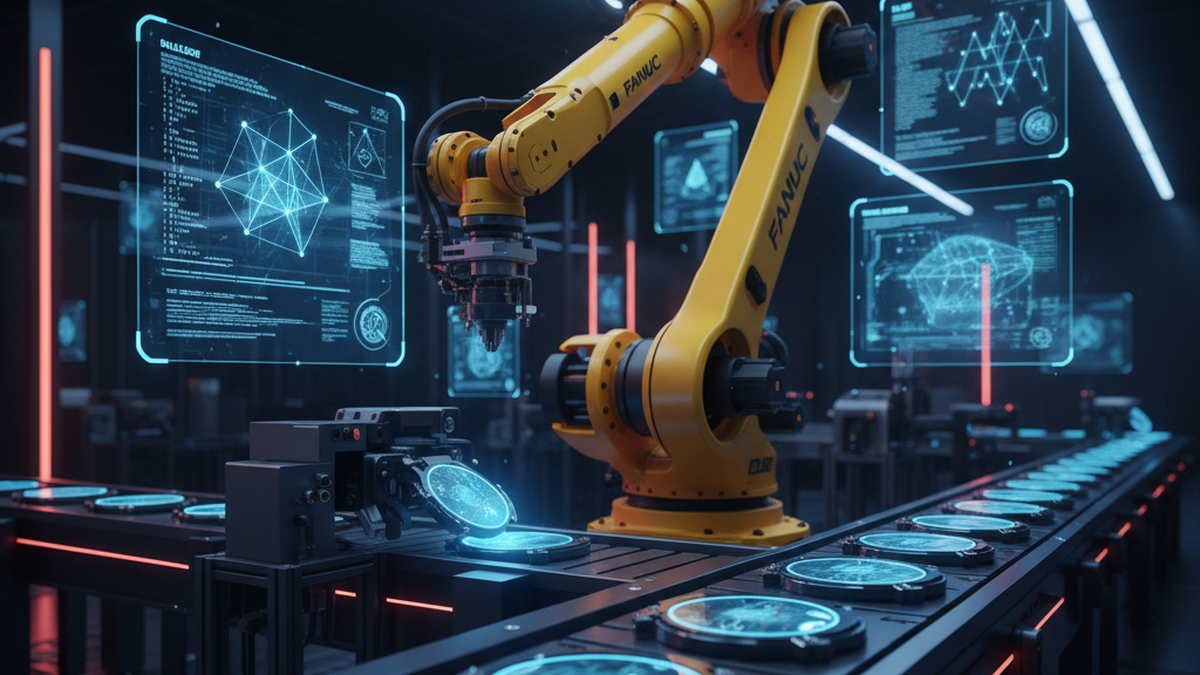
This architectural choice matters deeply. When FANUC, Japan's robotics giant, integrates NVIDIA Jetson edge modules into its robot controllers, it creates a feedback loop: better hardware demands better software, which demands better training data, which improves the hardware designs. That virtuous circle is what Japan seeks to institutionalise across its manufacturing base.
| Sector | AI Robotics Application | Target Timeline |
|---|---|---|
| Manufacturing | AI-guided assembly, predictive maintenance, quality control | 2028 |
| Healthcare | Surgical assistance, patient care, diagnostics | 2030 |
| Logistics | Autonomous warehousing, last-mile delivery | 2029 |
| Agriculture | Precision harvesting, crop monitoring drones | 2029 |
| Construction | Site surveying, heavy lifting, autonomous vehicles | 2031 |
| Disaster Response | Search and rescue, hazardous environment operations | 2030 |
The Semiconductor Bet
Japan's semiconductor ambitions rest on domestic production targets that rival the ambitions of the United States and China. The strategy commits to 15 trillion yen of domestic semiconductor output by 2030, scaling to 40 trillion yen by 2040. These aren't abstract industrial policy targets; they're designed to ensure Japan retains control over the silicon that powers its robotics innovation.
The country faces intense competition here. Recent trade agreements between Washington and Taipei have reshaped semiconductor supply chains, whilst China continues aggressive investments in domestic chip fabrication. Japan's strategy acknowledges these pressures by combining traditional semiconductor production with partnerships that blur boundaries between hardware and software development.
Japan is now promoting a comprehensive strategy that integrates foundation models, domain-specific AI models and company-specific AI systems by leveraging unique industrial data. We aim to drive innovation across all sectors from manufacturing to services.
Global Hubs and the Startup Wild Card
Rather than compete solely through large conglomerates, the strategy explicitly supports distributed research hubs where universities, corporations, and startups work alongside one another. This network approach mirrors what Singapore has achieved in broader AI adoption, creating density of talent and resources that attract international researchers.
One particularly intriguing signal comes from Integral AI, a 15-person startup founded by a former Google researcher. The company is in discussions with Toyota, Sony, Honda, Nissan, and Mitsui Chemicals. If Japanese firms can harness startup innovation while providing the manufacturing scale only incumbents possess, they unlock an asymmetric advantage against competitors whose industrial bases have fragmented.
Physical AI requires a fundamentally different approach to chip design. We are building silicon that thinks in three dimensions, not two, optimised for real-time sensor fusion on the factory floor.
The dual-track approach separates supply-side measures (robotic systems, components, foundational AI models) from demand-side incentives (government procurement across 16 priority sectors, deployment mandates). This prevents the classic problem of Japanese technology being excellent but underutilised domestically, which happened with earlier robotics breakthroughs.
The Timeline and Market Reality
The strategy sets 2030 as the benchmark✦ for widespread practical deployment and 2040 for achieving the 30% market share goal. That 10-year runway✦ acknowledges the time required to train workforces, integrate new systems into existing production, and prove reliability to risk-averse manufacturing sectors.
Frequently Asked Questions
Why is Japan focusing on Physical AI rather than large language models?
Japan's industrial dominance rests on reliability and precision manufacturing. Large language models generate revenue primarily through software licensing and advertising. Physical AI, by contrast, creates value through tangible applications in factories, logistics, and healthcare, where Japan already possesses unmatched expertise and customer relationships.
Can Japan really maintain 70% of the industrial robot market against Chinese competition?
China's robotics sector is advancing rapidly and benefits from lower labour costs. However, Japanese robots occupy the high-precision, high-reliability segment that customers prioritise over cost. Japan's strategy strengthens that advantage by adding AI capabilities that Chinese competitors will take years to match.
What role does international trade policy play?
Semiconductor supply chain resilience is central to the strategy. Recent agreements involving Taiwan, the US, and other nations make Japan's domestic production targets increasingly important for maintaining independence from geopolitical disruptions that could interrupt manufacturing cycles.
How does this compare to China's industrial AI push?
Both countries are investing heavily in robotics and AI, but with different priorities. China emphasises volume and cost reduction across diverse sectors. Japan emphasises precision, reliability, and deep integration with existing industrial customers, targeting higher-margin applications.
When will consumers notice these developments?
Industrial robotics deployments will manifest first in manufacturing and logistics sectors by 2028-2030. Consumer-facing applications, such as retail automation or last-mile delivery robots, will follow 2030 as costs decrease and reliability improves across service robotics domains.
The Japanese robotics sector stands at an inflection point. The country's historical dominance in industrial automation, combined with genuine AI breakthroughs in physical systems, creates an opportunity to recapture territory lost to software-centric AI narratives. Whether Japan executes this strategy faster than competitors attempt to copy it will determine if the 30% target is ambition or prophecy.
The stakes extend beyond market share. Whoever masters Physical AI will shape how manufacturing, healthcare, logistics, and construction operate for decades. Japan is betting that those who built the machines of the 20th century are best positioned to build the intelligent systems of the 21st. Drop your take in the comments below.






No comments yet. Be the first to share your thoughts!
Leave a Comment