

No Scandals, No Burnout, No Limits: K-Pop's Virtual Idols Are Taking Over
The biggest new act in Korean pop music has never eaten a meal, slept through an alarm, or posted an ill-advised tweet at 3am. PLAVE, a five-member boy group that exists entirely as animated avatars, sold over a million albums in a single week in February 2025, outselling most flesh-and-blood rivals. Their agency, VLAST, posted a 22 per cent profit margin that same year, nearly triple the industry average. And they are far from alone: across East Asia, virtual idols powered by AI, motion capture, and real-time rendering are selling out stadiums, topping Billboard charts, and forcing the entertainment industry to ask an uncomfortable question: do pop stars need to be real?
The answer, increasingly, is no. The virtual idol and VTuber market was valued at $2.27 billion in 2025 and is projected to reach $10.75 billion by 2035, with Asia-Pacific accounting for more than 80 per cent of global revenue (Business Research Insights, 2025). South Korea, Japan, and China are leading the charge, each approaching the trend from a different cultural and technological angle. But beneath the dazzling concert holograms and chart-topping streams lies a darker story: the same AI technologies that create virtual stars are being weaponised to exploit real ones.
The Rise of the Pixel Pop Star
By The Numbers
- 1.09 million: First-week album sales for PLAVE's PLBBUU single album in November 2025, making them the first virtual act to achieve consecutive million-seller releases (Soompi)
- $32.5 million: Annual revenue recorded by VLAST in 2024, with $7.1 million in operating profit (Korea JoongAng Daily)
- $5 million: Revenue from a single PLAVE pop-up store in Seoul over two months, seven times the average for fashion pop-ups (Cherry Chu Magazine)
- $2.27 billion: Global virtual idol and VTuber market valuation in 2025, projected to reach $10.75 billion by 2035 (Business Research Insights)
- 80%+: Asia-Pacific's share of global virtual idol revenue (Data Insights Market, 2025)
- 53%: Proportion of deepfake pornography victims online who are K-pop stars (Security Hero, 2024)
PLAVE's trajectory reads like a masterclass in what virtual idols offer that human performers cannot. The quintet, consisting of Yejun, Noah, Bamby, Eunho, and Hamin, are performed by real people wearing motion-capture suits, their movements and voices translated into anime-styled 3D characters in real time. They debuted in March 2023 through YouTube and V Live streams, bypassing the gruelling trainee system that has defined K-pop for decades. Within two years, they were selling out KSPO Dome and Gocheok Sky Dome, two of South Korea's five largest concert venues, for their DASH: Quantum Leap Asia tour spanning Seoul, Taipei, Hong Kong, Jakarta, Bangkok, and Tokyo.
Their third mini album, Caligo Pt. 2, is set for release on 13 April 2026, with concept films and teasers already generating millions of views. The title track from its predecessor, "DASH," made history as the first virtual idol song to chart on the Billboard Global 200, landing at number 195 in February 2025. On Melon, South Korea's dominant streaming platform, the album racked up 11 million streams within 24 hours.
Virtual idols offer stability without military hiatus, scandals, or burnout. The economic model is fundamentally different from traditional K-pop.
The financial appeal is hard to ignore. Traditional K-pop agencies invest years and millions of dollars training human idols who may never debut, and those who do face mandatory military service (for male artists), dating scandals that can tank stock prices overnight, and the ever-present risk of mental health crises. VLAST's 22 per cent operating margin dwarfs the 8 per cent recorded by Cube Entertainment, a mid-tier agency managing human groups, during the same reporting period. A Seoul pop-up store for PLAVE merchandise generated $5 million in just two months.
The Technology Behind the Illusion
The technical infrastructure powering virtual idols has matured rapidly. MAVE:, a four-member virtual girl group launched by Netmarble subsidiary Metaverse Entertainment in January 2023, showcased what hyper-realistic virtual performers could look like. Built using Unreal Engine and MetaHuman technology, MAVE:'s members were designed with AI-based facial rendering and voice synthesis capable of performing in Korean, English, French, and Bahasa. Their debut single "PANDORA" accumulated over 28 million YouTube views, and the group secured brand ambassador deals with PUBG Mobile.
The technology stack typically combines several layers. Motion-capture suits record a human performer's movements in real time. AI-driven✦ facial animation systems translate micro-expressions onto digital characters. Voice synthesis tools can enhance, modify, or in some cases entirely generate vocal performances. Real-time rendering engines, primarily Unreal Engine 5, display the final result at concert quality.
HYBE, the conglomerate behind BTS, entered the space in June 2024 with Syndi8, a virtual pop group whose vocals are entirely AI-generated, set in a fictional universe called "Nansy Land." The move signalled that even the industry's largest player sees virtual talent as a strategic priority, not a novelty.
| Group | Debut | Agency | Technology | Key Achievement |
|---|---|---|---|---|
| PLAVE | Mar 2023 | VLAST | Motion capture + real-time 3D | 1.09M first-week album sales |
| MAVE: | Jan 2023 | Metaverse Ent. (Netmarble) | Unreal Engine + MetaHuman + AI voice | 28M+ YouTube views for PANDORA |
| Syndi8 | Jun 2024 | HYBE | Fully AI-generated vocals | First major-label all-AI vocal group |
| Hatsune Miku | Aug 2007 | Crypton Future Media | Vocaloid synthesis | Pioneer; global concert tours since 2009 |
| A-SOUL | Nov 2020 | ByteDance / Yuehua | Motion capture + live streaming | China's most popular VTuber group |
Japan, of course, pioneered the concept. Hatsune Miku, the turquoise-haired Vocaloid created by Crypton Future Media in 2007, has been filling arenas with holographic concerts for nearly two decades. She remains a cultural icon and commercial powerhouse, demonstrating the long-term viability of virtual performers. In China, ByteDance-backed A-SOUL became the country's most-watched virtual idol group through live streaming on Bilibili, though the project faced controversy in 2022 when it emerged that the real performers behind the avatars were being paid a fraction of the revenue they generated.
The Deepfake Shadow
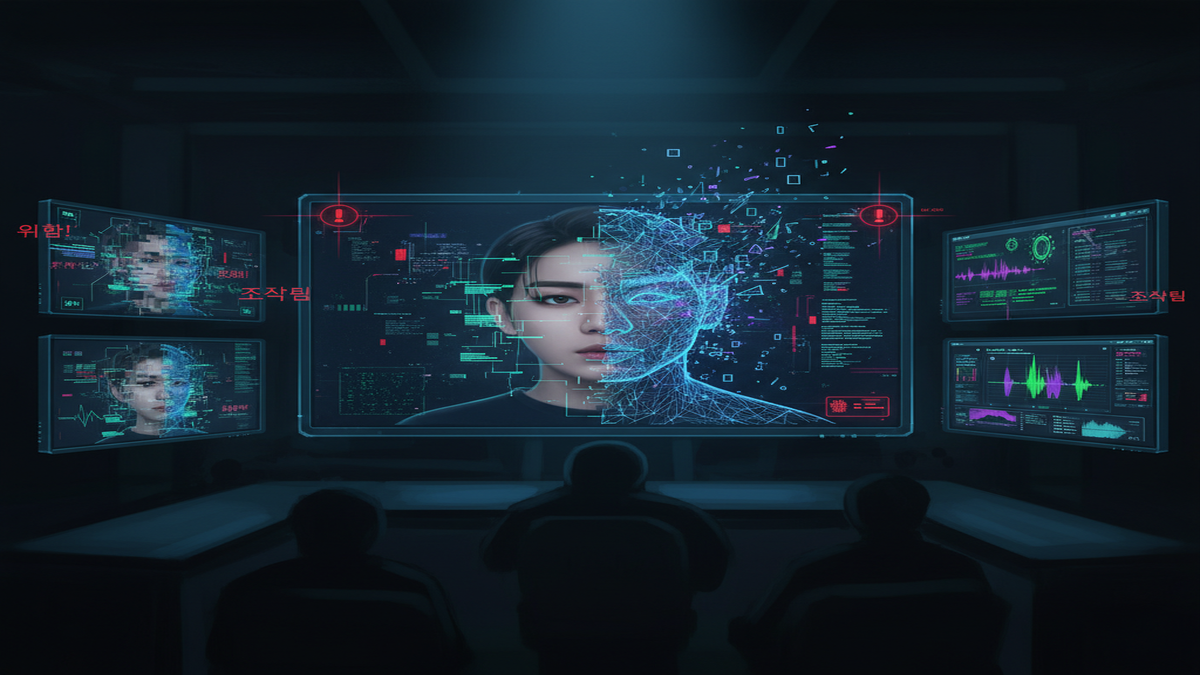
For every headline celebrating virtual idol innovation, another documents the darker applications of the same underlying technology. A 2024 report by Security Hero found that 53 per cent of individuals featured in non-consensual deepfake pornography online are K-pop stars, a staggering figure that reflects both the global reach of Korean pop culture and the ease with which AI image-generation tools can be misused.
The crisis prompted swift legislative action. South Korea's National Assembly passed amendments to the Act on Special Cases with Respect to Punishing Sex Crimes, imposing penalties of up to seven years in prison for creating or distributing sexually explicit deepfakes. In a significant expansion, the law also criminalised the mere possession or viewing of such material, carrying penalties of up to three years' imprisonment or fines of 30 million won (approximately $22,600). In April 2025, the government launched the National Centre for Digital Sexual Crime Response, a 24/7 hub coordinating reporting, counselling, and content deletion support across all 17 provinces.
Virtual K-pop is a double-edged sword. The same AI that creates new forms of artistic expression also enables new forms of exploitation.
The irony is not lost on industry observers. The motion-capture and facial-rendering technologies that make PLAVE's concerts possible share DNA with the tools used to generate non-consensual deepfakes. As South Korea invests $560 million in AI commercialisation, the tension between fostering innovation and preventing harm has become one of the defining policy challenges of the AI era.
Courts have begun awarding punitive damages of up to five times proven losses against platforms that distribute manipulated content, while the country's media regulator can now fine outlets up to 1 billion won ($684,000) for repeatedly distributing content confirmed to be false or AI-manipulated.
What Fans Really Think
Fan reception to virtual idols is neither uniformly enthusiastic nor dismissive. PLAVE's fandom, known as PLI, has grown fiercely loyal. Supporters point to the group's authenticity: the members regularly interact with fans through live streams, share personal stories, and display distinct personalities that feel genuine despite the animated veneer. The sold-out Asia tour and $5 million pop-up store haul speak to a fanbase willing to spend real money on virtual performers.
Yet scepticism persists in corners of the K-pop community. Some fans argue that the absence of a physical presence diminishes the emotional connection that drives parasocial relationships in K-pop. Others worry about the broader implications for human creativity in an industry already criticised for treating its performers as interchangeable products.
The generational divide is notable. Younger fans, raised on VTubers, gaming avatars, and digital-first content, appear more comfortable with the concept. A Korea Times analysis described virtual K-pop as appealing precisely because it eliminates the scandals, military-service hiatuses, and mental health crises that have rocked the traditional entertainment industry. For agencies, the calculus is increasingly straightforward: virtual idols can promote products in multiple languages simultaneously, appear at events in different cities on the same day, and never age.
Frequently Asked Questions
Are virtual K-pop idols performed by real people?
It depends on the group. PLAVE uses real human performers in motion-capture suits whose movements and voices are translated into animated characters in real time. MAVE: used a hybrid of human vocal performance and AI voice synthesis. HYBE's Syndi8 features entirely AI-generated vocals with no disclosed human performers behind the characters.
How much money do virtual idol groups make?
PLAVE's agency VLAST recorded $32.5 million in revenue in 2024 with a 22 per cent operating margin. A single Seoul pop-up store generated $5 million in two months. The global virtual idol and VTuber market was valued at $2.27 billion in 2025, with Asia-Pacific accounting for over 80 per cent of that figure.
Why are K-pop stars disproportionately targeted by deepfakes?
A 2024 Security Hero report found that 53 per cent of deepfake pornography victims are K-pop idols. The combination of K-pop's global visibility, the abundance of high-quality training imagery from music videos and photo shoots, and obsessive fan subcultures creates ideal conditions for malicious deepfake creation.
What laws exist to combat deepfakes in South Korea?
South Korea amended its sex crime laws to impose up to seven years' imprisonment for creating or distributing sexually explicit deepfakes. Possessing or viewing such content carries up to three years' imprisonment or fines of 30 million won ($22,600). The government also launched a National Centre for Digital Sexual Crime Response in April 2025.
Will virtual idols replace human K-pop stars?
Industry analysts view virtual and human idols as coexisting rather than competing. Virtual groups offer cost efficiency and risk reduction, but human performers retain advantages in spontaneity, physical presence, and the emotional depth of live performance. The two formats are likely to develop in parallel, with some agencies managing both.
The Stage Ahead
The virtual idol wave in East Asia is not a passing trend; it is a structural shift in how entertainment is produced, distributed, and consumed. PLAVE's upcoming Caligo Pt. 2 release in April 2026 will test whether the group can sustain its million-seller momentum. HYBE's continued investment in AI-generated performers suggests the industry's biggest players are betting long. And as the technology improves, the line between virtual and human performance will only grow harder to spot.
The question is no longer whether audiences will accept virtual pop stars. They already have. The question is whether the industry can build this new world without repeating the old one's worst mistakes. Drop your take in the comments below.






Latest Comments (4)
VLAST's 22 percent profit margin? That's actually huge for entertainment agencies, yaar, most struggle to hit double digits only. When you look at the whole virtual idol market projected to hit $10.75 billion by 2035, you realize the deep tech play here is just immense. We've seen similar models emerging in India, for virtual influencers and even some e-commerce avatars using real-time rendering. The ability to scale without the usual human talent limitations and controversies... it really changes the unit economics. The AI and motion capture, very powerful only, though the deepfake part is something to watch out for na. But the core opportunity, that's what we are funding, ya know?
its definitely remarkable to see the virtual idol market hitting $2.27 billion, projected to $10.75 billion. The financial success of groups like PLAVE is undeniable. But as an AI ethicist, I always wonder about the distribution of these opportunities and the tech that powers them. If Asia-Pacific accounts for 80% of global revenue, it compels us to ask how accessible this technology truly is outside these leading nations. Is the innovation genuinely global, or are we just reinforcing existing tech divides? We often see breakthroughs concentrated, leaving many regions behind in both creation and benefit
plave selling a million albums underscores ai's incredible capabilities for consistent performance. we were just discussing similar applications last month at my company - imagine ai that consistently delivers precision diagnoses without burnout. it highlights the vast potential, even if our regulatory environment is very different.
Very impressive! PLAVE million albums sales truly show how far real-time rendering and motion capture technologies have come. In my computer vision research at Tsinghua we look at avatar generation and making human-like expressions very natural. This $2.27 billion market growing to $10.75 billion by 2035 means more need for robust AI. We discuss using models like Qwen for speech sync, but also developing stronger detection for the deepfake problem article mentions. This need for ethical and robust AI for virtual idols is big challenge
Leave a Comment