

Anthropic's research reveals AI could trigger a white-collar jobs crisis - but the gap between capability and reality is enormous
Every major technological revolution has rendered entire job categories obsolete. Electricity killed the lamplighter and the knocker-up. The computer finished off the switchboard operator and the data entry clerk. Now Anthropic, one of the world's most closely watched AI companies, has published research mapping precisely which professions stand in the path of AI job displacement - and the picture is more nuanced, and more alarming, than most headlines suggest.
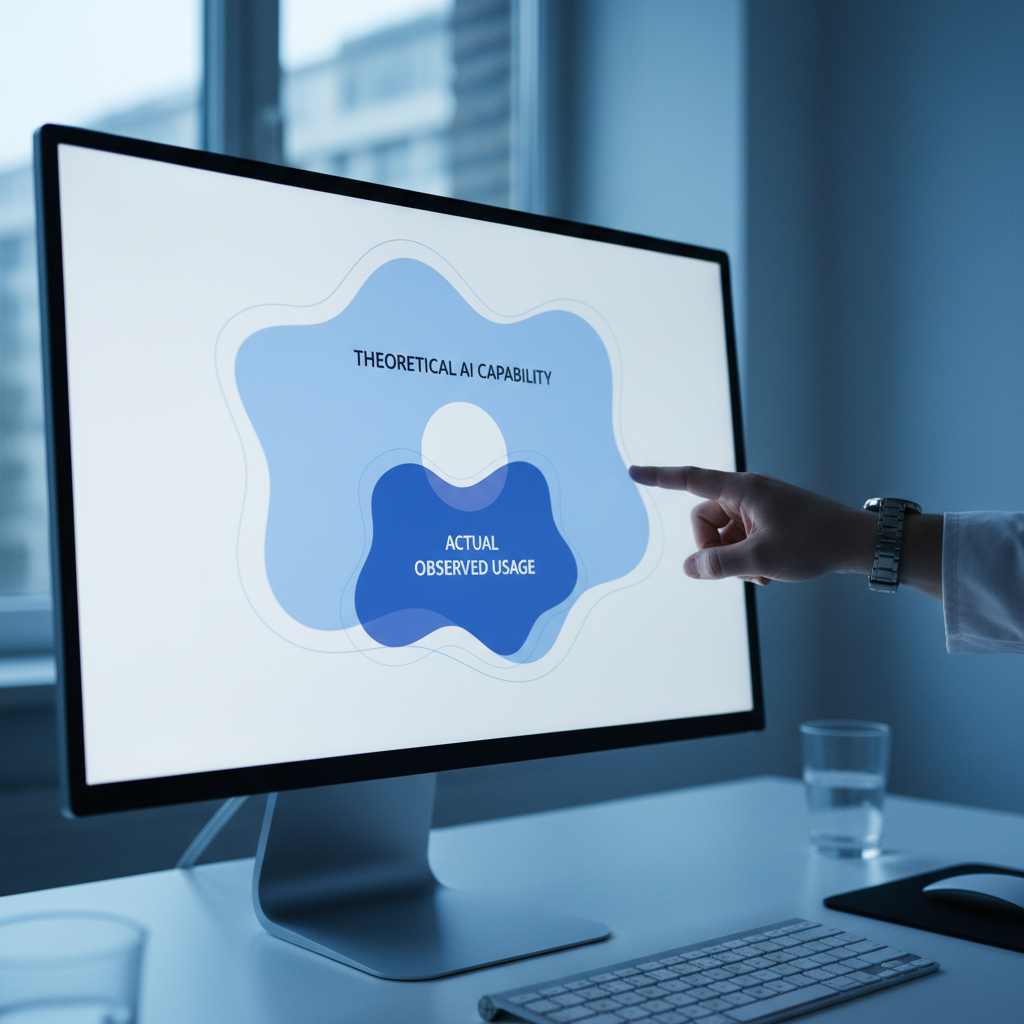
The study, titled "Labour Market Impacts of AI: A New Measure and Early Evidence," authored by Maxim Massenkoff and Peter McCrory, introduces a new metric called "observed exposure". This measures not just what AI could theoretically do to a job, but what it is actually doing right now. The gap between those two numbers is the story.
By The Numbers
- AI tools are theoretically capable of handling 94% of tasks performed by computer and maths workers - but observed usage via Claude covers only 33%.
- Office and administrative roles face 90% theoretical AI exposure, yet actual adoption remains a fraction of that.
- The most AI-exposed workers earn 47% more on average than the least exposed group.
- Young workers in AI-exposed fields have seen a 14% drop in job-finding rates in the post-ChatGPT era compared to 2022.
- Approximately 30% of workers face zero AI exposure - cooks, mechanics, bartenders - roles requiring physical presence no LLM✦ can replicate.
The Capability Gap: Theoretical Power vs. Real-World Adoption
The most striking finding in the Anthropic research is the sheer distance between what AI can theoretically do and what it is actually doing in professional settings. Researchers measured real-world usage by analysing work-related interactions with Claude, Anthropic's flagship AI model. What they found should prompt both relief and urgency in equal measure.
AI can theoretically cover the majority of tasks in business and finance, management, computer science, mathematics, legal, and office administration. Yet in virtually every sector, actual adoption is a fraction of theoretical capability. The "red area" of real usage, as the researchers describe it, is dwarfed by the "blue area" of what is possible. Legal constraints, model limitations, the need for additional software integration, and the ongoing requirement for human review are all slowing adoption - for now.
"Labour market conditions are evolving in ways that are just barely statistically significant - but the direction is clear." - Maxim Massenkoff and Peter McCrory, Anthropic Research
The researchers are explicit that these barriers are temporary. As capabilities improve and enterprise adoption deepens, the red will grow to fill the blue. The question for workers and policymakers alike is not if that happens, but when - and whether institutions will be ready.
Who Is Actually at Risk from AI Job Displacement?
The profile of the worker most threatened by AI job displacement is not the warehouse operative or the manual labourer. It is someone far more likely to have a graduate degree, a high salary, and years of professional training behind them. The Anthropic data is unambiguous on this point.
- The most AI-exposed group is 16 percentage points more likely to be female than the least exposed group.
- They earn 47% more on average.
- They are nearly four times as likely to hold a graduate degree.
- The most exposed occupations include computer programmers, customer service representatives, and data entry keyers.
- Fields with the highest theoretical exposure include law, financial analysis, software development, and office administration.
The researchers offer a concrete example of the gap in action. Authorising drug refills to pharmacies is a task a doctor performs routinely and one that AI is technically capable of handling. Yet the research found no observed evidence of Claude performing this task in professional settings. The capability exists. The deployment does not. Yet.
"AI could disrupt✦ half of entry-level white-collar work." - Dario Amodei, CEO, Anthropic
Amodei's warning is matched by Microsoft's AI chief Mustafa Suleiman, who has estimated that most professional work will be replaced within one to eighteen months. These are not fringe predictions. Federal Reserve Governor Michael S. Barr raised AI-driven✦ unemployment as one of three plausible scenarios for the US economy in a recent speech - placing it firmly within mainstream institutional thinking.
The 'Great Recession for White-Collar Workers' Scenario
The Anthropic paper names the scenario bluntly: a "Great Recession for white-collar workers." During the 2007 to 2009 financial crisis, the US unemployment rate doubled from 5% to 10%. The researchers note that a comparable doubling in the top quartile of AI-exposed occupations - from 3% to 6% - would be clearly detectable using their framework. It has not happened yet. But they are explicit that it absolutely could.
The February 2026 US jobs report added urgency to this debate. Employers shed 92,000 jobs, and the unemployment rate rose to 4.4%. Some high-profile layoffs have been attributed, at least in part, to AI. Jack Dorsey's payments firm Block cut nearly half its workforce, with Dorsey citing AI-enabled leaner teams as a structural shift rather than a one-off cost reduction.
Critics, including Salesforce CEO Marc Benioff, have suggested that framing layoffs as AI-driven may be "AI washing✦" - using the technology as cover for cuts that were necessary for other reasons. That scepticism is reasonable, but it does not dissolve the underlying trend. The hiring slowdown in AI-exposed fields is real, even if the unemployment figures have not yet moved dramatically.
| Occupation Category | Theoretical AI Exposure | Observed Claude Usage | Exposure Gap |
|---|---|---|---|
| Computer and Maths | 94% | 33% | 61 percentage points |
| Office and Administrative | 90% | Low (fraction) | Very high |
| Legal | High | Limited | High |
| Physical/Trade Roles | 0; 5% | ~0% | Negligible |
The hiring slowdown is arguably the more instructive signal. Research finds a 14% drop in job-finding rates for young workers in AI-exposed occupations since ChatGPT's arrival - compared to 2022 baselines. A separate study found a 16% fall in employment among workers aged 22 to 25 in AI-exposed jobs. For some young workers, that means remaining in existing roles, pivoting to adjacent fields, or returning to education. The economy is quietly adjusting before the unemployment statistics catch up.
For more on the cognitive and wellbeing pressures that accompany AI-driven productivity shifts, our analysis of the hidden burnout risks of AI-powered workplaces is essential reading for managers and employees alike.
The Asia-Pacific Picture
The Anthropic findings carry particular weight across Asia-Pacific, where white-collar employment in knowledge-intensive sectors has expanded rapidly over the past two decades. Countries like India, the Philippines, and Malaysia have built significant portions of their economies on exactly the occupations the research flags as most exposed: software development, customer service, data processing, and business process outsourcing.
India's IT services sector, which employs millions of graduates in roles including software engineering and data analysis, faces a specific version of this challenge. Infosys, Wipro, and Tata Consultancy Services have all publicly discussed AI-driven productivity gains - which, in plain terms, means fewer people needed to deliver the same output. The hiring slowdown documented in the Anthropic research is already visible in Indian IT campus recruitment figures, which have contracted meaningfully since 2023.
The Philippines, home to one of the world's largest business process outsourcing industries, is watching this research closely. Customer service and data entry roles - two of the three most exposed occupations identified in the Anthropic study - are the backbone of the BPO sector that employs over 1.5 million Filipinos. Regulators and trade bodies there have begun exploring reskilling frameworks, but the pace of policy response has not matched the pace of AI capability growth.
China's approach is instructive by contrast. Beijing has pursued an aggressive national strategy to both accelerate AI adoption and manage its labour market consequences, an approach we have covered in depth in our analysis of China's five-year AI technology push. Singapore, meanwhile, has positioned itself as a regional hub for AI governance✦, with the Infocomm Media Development Authority actively developing frameworks that attempt to balance innovation with workforce protection.
The energy infrastructure required to run these AI systems at scale✦ is also a regional concern. Asia-Pacific is already grappling with data centre capacity constraints - a challenge explored in our coverage of innovative approaches to the region's AI energy crisis. More AI capability means more compute✦ demand, which means more pressure on grids that are already strained.
What Slows AI Adoption - and Why That Buys Time, Not Safety
The researchers identify four primary factors holding back AI adoption from reaching its theoretical ceiling. Understanding these is important: they are brakes, not walls.
- Legal and regulatory constraints - many professional roles involve liability that organisations are not yet willing to assign to an AI system.
- Model limitations - current large language models still make errors that are unacceptable in high-stakes professional contexts.
- Integration complexity - AI tools often require additional software infrastructure and workflow redesign before they can replace human tasks at scale.
- Human review requirements - in many regulated industries, a qualified human must sign off on AI-generated outputs, preserving some employment even as it reduces the skill required.
These constraints are real. But they are diminishing. Each new model generation reduces error rates. Regulatory frameworks are being written now that will normalise AI decision-making. Integration tooling is maturing rapidly. The 61-percentage-point gap between what AI can do for a software developer and what Claude is currently observed doing is not a permanent safety buffer - it is a countdown.
For workers considering how to navigate this landscape, our coverage of how small businesses are turning AI into a competitive advantage offers practical context for how the workforce is adapting at the ground level.
Anthropic's own Claude model has been gaining users rapidly precisely because it performs well on complex knowledge tasks - the same tasks the research flags as most exposed. The model is simultaneously the subject of this research and its instrument.
Frequently Asked Questions
Which jobs are most at risk from AI replacement according to the Anthropic research?
The Anthropic study identifies computer programmers, customer service representatives, and data entry keyers as the most exposed occupations. Broader categories at high theoretical risk include legal, financial analysis, software development, and office administration roles. Crucially, these are higher-earning, graduate-educated positions - not low-wage manual jobs.
Is AI actually replacing white-collar jobs right now?
Not at scale - yet. The research shows a significant gap between what AI is theoretically capable of and what it is actually observed doing in professional settings. For computer and maths workers, AI could handle 94% of tasks but currently covers only 33% in practice. The more immediate signal is a slowdown in hiring in AI-exposed fields, particularly among young workers, rather than a wave of direct layoffs.
What is the 'Great Recession for white-collar workers' scenario?
The Anthropic researchers use this term to describe a plausible scenario in which AI adoption drives unemployment in knowledge-economy occupations in a manner comparable to how the 2007 to 2009 financial crisis hit the broader labour market. During that crisis, US unemployment doubled from 5% to 10%. The researchers note that a comparable doubling in the top quartile of AI-exposed roles - from 3% to 6% - has not yet occurred but is measurable within their framework and remains a genuine risk.
If you work in a field the data identifies as highly exposed - legal, software, finance, customer service - what is your employer actually doing to prepare for the capability gap closing? Drop your take in the comments below.






No comments yet. Be the first to share your thoughts!
Leave a Comment