

How AI and UGC Are Rewriting the Rules of Game Creation
The gaming industry is undergoing a structural transformation that goes well beyond better graphics or faster load times. A new generation of AI-powered✦ tools is collapsing the barrier between consumer and creator, enabling solo developers, streamers, and even children to produce professional-grade digital assets for the world's largest gaming platforms. At the centre of this shift is a Singapore-headquartered company called Ambitionz, whose AI model Cipher is purpose-built to democratise game development at scale✦.
By The Numbers
- USD 1 billion paid by Roblox to creators in 2024 alone, according to a Ken Research report published in 2025
- 44% of children begin gaming by age 5, and 77% by age 7, with first exposure concentrated on UGC platforms like Roblox and Minecraft
- 55% of gamers have tried a game recommended by a favourite creator, making influencers a primary demand engine in the industry
- 15,20% lift in in-app purchase uptake recorded by studios using real-time player state data, according to Game State Labs (2025)
- 75% of 3D artists are expected to use AI assistance by 2025, marking a fundamental shift in creative workflows
The Platform Game Economy Has Already Arrived
Gaming's evolution into a social and cultural infrastructure is no longer a prediction , it is documented fact. Platform-style games such as Roblox, Fortnite, and Minecraft have displaced traditional AAA titles in the habits of younger audiences. These platforms offer a living, ever-updating ecosystem✦ rather than a fixed narrative, and that distinction is proving decisive.
The Bain & Company 2025 Gaming Report captures the generational dynamics at play with clarity. Video games are now the most popular form of media for those under 18, and younger players are significantly more concentrated around a short list of top titles than older cohorts.
"Those aged between 2 and 17 are 20 percentage points more likely than gamers aged 35 and older to prefer playing the short list of games that are most popular among their peers." , Bain & Company, 2025 Gaming Report
The stickiness of these platforms is equally striking. The percentage of Roblox users aged 13 and older increased from roughly 50% in 2021 to around 60% in 2024, as users who joined young continued playing as they matured. This kind of platform loyalty creates a durable structural advantage that conventional game publishers are finding difficult to replicate.
User-Generated Content Is Now a Foundational Pillar
The rise of these open platforms has produced a boom in user-generated content (UGC) that is reshaping how gaming value is created and distributed. UGC is no longer a peripheral feature. It is, increasingly, the product itself.
According to Ken Research, 40% of gamers reported consuming more UGC in the past year. The supply side is expanding just as rapidly. Gen Alpha , the cohort now aged roughly 0 to 15 , is entering gaming not as passive consumers but as active creators, a trend rooted in early platform exposure.
"UGC is no longer additive but is becoming a foundational pillar of engagement and monetisation." , Ken Research, UGC Gaming Economy Report, 2025
This dynamic has tangible financial consequences. Roblox's USD 1 billion creator payout in 2024 demonstrates that independent creators can now build viable economic livelihoods within gaming platforms. Fortnite, through its UEFN (Unreal Editor for Fortnite) toolset, has similarly opened its ecosystem to outside creators and is paying out substantially. The UGC market is projected to maintain a double-digit compound annual growth rate through 2030.
The intelligence layer is becoming equally important. Studios leveraging real-time player state data , analysing actions moment by moment rather than relying on aggregate averages , have recorded 15,20% lifts in in-app purchase uptake by serving the right asset or difficulty adjustment at the precise point of player friction. Precision is replacing guesswork as the competitive differentiator.
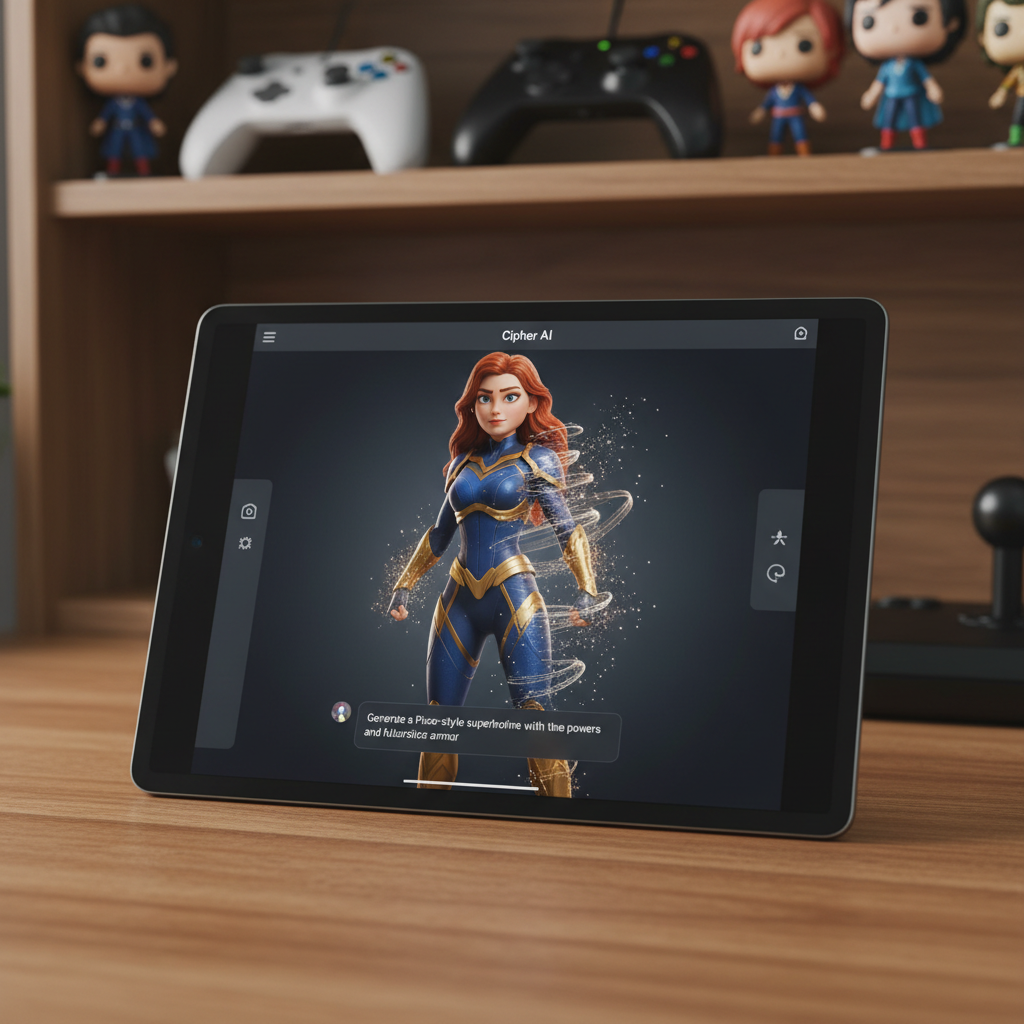
Cipher: The AI That Thinks Like a Game Developer
Into this environment steps Ambitionz, a Singapore-headquartered company with an AI model called Cipher. The platform is explicitly positioned to close the skills gap that has historically limited UGC creation to those with technical expertise in 3D modelling, rigging, and game engine integration.
Cipher's interface is intentionally familiar: a creator describes what they want via chat, uploads a reference image, and generates a character, prop, or environment. The exported asset is delivered in the native format required by the target platform, whether that is Fortnite via UEFN, Roblox, or any Unity or Unreal Engine-based game. As games like Grand Theft Auto, PUBG, and Call of Duty expand their own UGC components, Cipher intends to integrate those as well.
Pavel Bains, CEO of Ambitionz, framed the opportunity in straightforward terms when speaking to Entrepreneur.
"Our tagline is 'Build Your Own Gaming Empire'. We enable someone with no technical skills to create a character , like a Pixar-style superhero , and drop it into Roblox to start playing within 10 minutes." , Pavel Bains, CEO, Ambitionz
The roadmap extends beyond static 3D assets. Ambitionz is already implementing particle effects, lighting, and physics capabilities. The longer-term vision includes full level construction, complete game builds, and a built-in marketplace where creators can sell and trade the content they produce. This positions Cipher not merely as a creation tool but as a vertically integrated creator economy platform.
Bains also addressed the question of content moderation directly. The company applies industry standards and filters to prevent harmful or infringing content, particularly given the young demographic. But he was candid about the limits of what any platform can police: much like Adobe cannot prevent misuse of Photoshop, Ambitionz cannot control every downstream application of Cipher's outputs.
The Asia-Pacific Picture
Ambitionz choosing Singapore as its base is not incidental. Southeast Asia has emerged as one of the most strategically significant regions for gaming, driven by mobile-first infrastructure, a young and rapidly growing middle class, and governments increasingly viewing the creative tech sector as an economic priority.
Singapore's status as a regional technology hub gives Ambitionz access to a talent pool, regulatory stability, and proximity to markets across Southeast and East Asia where gaming penetration is accelerating. Indonesia, the Philippines, and Vietnam are among the fastest-growing gaming markets in the world by player count. Vietnam, notably, has also been the first Southeast Asian country to enforce a dedicated AI law, signalling that the regulatory environment around AI-generated content in gaming will become increasingly relevant for companies like Ambitionz operating across the region.
The demographic data underpinning the UGC boom is particularly resonant in Asia-Pacific. With a disproportionately young population across much of Southeast Asia, the cohort of Gen Alpha creators entering platforms like Roblox is substantial and growing. Regional gaming communities have also developed strong creator cultures, with influencer-driven discovery already established as a primary route to game adoption.
Meanwhile, the broader deployment of AI tools across Asian consumer platforms suggests that gaming will not be isolated in its adoption of AI-assisted creation. The pattern of AI lowering technical barriers is consistent across sectors, and gaming , given its scale and the economic incentives already in place , may be one of the first areas where that democratisation reaches genuine mass-market penetration in Asia-Pacific.
Addressing the Sceptics: Purists, Clutter, and Quality Control
The introduction of AI into creative workflows rarely arrives without pushback. Gaming is no exception, and concerns from what Bains describes as "purists" are predictable and worth taking seriously.
The specific objections tend to cluster around a few themes:
- Quality dilution: Will an influx of AI-generated assets lower the overall standard of content on platforms?
- IP infringement: Can AI tools reliably distinguish between original creation and derivative works that violate intellectual property?
- Creator displacement: Does democratised creation threaten the livelihoods of professional 3D artists and game designers?
- Platform coherence: Will games become cluttered or incoherent as the volume of UGC scales exponentially?
Bains draws historical parallels to previous waves of disruption within gaming. Mobile gaming, free-to-play models, and Twitch streaming all faced similar resistance before being absorbed into the mainstream and expanding the overall market. Each lowered a barrier to participation and ultimately grew the audience rather than fragmenting it. The pattern of initial resistance to AI tools across industries suggests that gaming is following a well-worn path.
The more substantive concern is around moderation and intellectual property. Platforms like Roblox and Fortnite already maintain significant content moderation infrastructure. As AI-generated assets scale, the burden on that infrastructure will grow, and regulatory frameworks , particularly in markets like the EU and increasingly in Asia , will likely impose additional compliance requirements.
From Fixed Content to Infinite Iteration
The deeper structural shift here is a transition from a fixed-content model to an infinite-iteration model. Traditional game development operated on a cycle of release, patch, and sequel. The UGC-plus-AI paradigm removes that ceiling.
Consider the contrast:
| Traditional Game Development | AI-Assisted UGC Model |
|---|---|
| Large studio teams, multi-year cycles | Solo creators, assets produced in minutes |
| Fixed content at launch, periodic patches | Continuous, community-driven content iteration |
| Revenue concentrated in publisher | Revenue distributed to creator network |
| Technical skills required for creation | Natural language and image prompts sufficient |
| Platform as delivery mechanism | Platform as living ecosystem |
This is not a marginal adjustment. It is a fundamental restructuring of who makes games, how they are made, and how value flows through the industry. The question for established publishers is not whether to engage with this model but how quickly they can adapt to it. The barriers to meaningful AI transformation in large organisations are well-documented, and gaming studios are not immune to those dynamics.
For individual creators, the opportunity is immediate. Platforms that pay creators directly, combined with tools that remove technical barriers to content production, represent a genuinely new economic on-ramp. The parallel disruption in software development driven by AI-assisted coding suggests that gaming creation may follow a similar trajectory: skills that once required years of training becoming accessible in months.
Frequently Asked Questions
What is UGC in gaming and why does it matter?
User-generated content (UGC) in gaming refers to assets, levels, characters, and experiences created by players and independent developers rather than the game's original studio. It matters because platforms like Roblox and Fortnite have built entire economies around UGC, paying creators billions of dollars annually and making community-driven content a primary driver of engagement and revenue.
How does AI like Cipher change game asset creation?
AI tools like Cipher allow creators without technical skills in 3D modelling or game engine programming to produce professional-grade assets using natural language descriptions and image uploads. The output is delivered in the native format required by specific platforms, collapsing what was previously a multi-week workflow into minutes.
Is the UGC gaming market growing in Asia?
Yes. Southeast Asia in particular is one of the fastest-growing regions for gaming by player count, with markets like Indonesia, Vietnam, and the Philippines experiencing rapid growth. The young demographic profile across much of the region aligns closely with the Gen Alpha creator cohort that UGC platforms are specifically designed to serve.
Given that platforms like Roblox are already paying out billions to creators globally, how well-positioned is your market or organisation to capture a share of that creator economy before the window narrows? Drop your take in the comments below.






No comments yet. Be the first to share your thoughts!
Leave a Comment