

India's AI-for-Farming Model Reshapes South Asia
India's AI Impact Summit 2026 in February brought together heads of state and tech leaders to establish a framework that could reset South Asia's approach to AI governance and rural deployment. But the real story is simpler: Indian AI, built for subsistence farmers, is quietly becoming the region's de facto model, not through policy mandates, but through tangible adoption that works.
Sarlaben, AMUL's AI assistant, now guides 3.6 million dairy farmers on cattle health and productivity in local languages. These are predominantly women with no smartphone literacy. The system sends voice messages in Gujarati, Telugu, and Hindi; farmers respond via missed calls to dial codes representing actions. One 22-minute average session per farmer per week drives measurable productivity gains. This is not academic AI. This is 3.6 million people in South Asia using AI to survive. Compare this scale to how Sarvam AI is building India's sovereign foundation models, which underpin applications like Sarlaben.
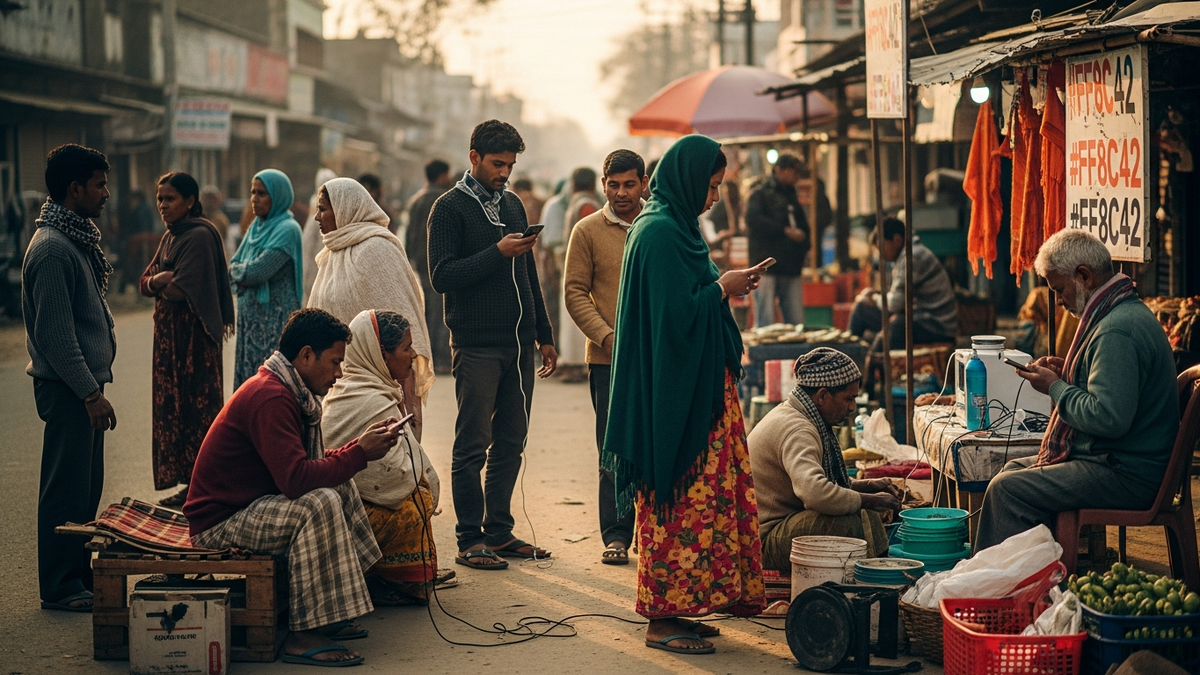
What India's MANAV Framework Actually Says
India codified its philosophy in the MANAV governance framework, which rests on five pillars: Moral and Ethical Systems, Accountable Governance, National Sovereignty, Accessible and Inclusive development, and Valid and Legitimate verification. Unlike Western regulation, MANAV anchors AI in human values while protecting national data rights, a positioning that matters in a region where trust in foreign tech platforms remains fragile.
The framework's emphasis on data sovereignty signals regional intent. Bangladesh, Pakistan, and Sri Lanka have all explored AI regulations in parallel, but often in isolation. India's summit created political space for coordinated thinking without imposing it.
The framework anchors AI governance in human values while protecting national data rights, a significant positioning against Western regulatory models.
Practical infrastructure followed philosophy. Under India's AI Mission, the government deployed thousands of GPUs at "highly affordable rates" to enable startups to compete globally. A national AI Repository democratises access to datasets and AI models, addressing the compute gap that previously locked out smaller players. This is the opposite of centralism: democratised access is regionalism's prerequisite.
Regional Fragmentation Remains
The reality is messier. Beyond India, search results do not provide specific evidence of Bangladesh, Pakistan, Sri Lanka, or Nepal launching AI governance frameworks, language models, or government-backed infrastructure programs as of April 2026. Global surveys from sources like Reuters count more than 70 countries with AI policies or draft laws, but South Asia outside India remains underreported in English-language sources.
Pakistan's tech sector has quietly grown strong. Pakistani developers and AI researchers contribute significantly to global AI talent pools, yet Pakistan has not published a national AI strategy with the visibility of India's Mission or Thailand's initiatives. Sri Lanka positioned itself as a hub for AI services and training but lacks public commitments to compute infrastructure. Nepal's AI ecosystem remains nascent, though universities are beginning to integrate AI into curricula.
This fragmentation means India's models, MANAV, Sarlaben, GPU democratisation, become de facto standards by default. Neighbouring countries adopt Indian solutions because they work and because regional alternatives are sparse. See how India's AI talent export is now compounding across South Asia.
The Sarlaben Precedent
Sarlaben is instructive because it solves a problem that affects 300 million smallholder farmers across South Asia. Voice-based AI avoids literacy as a barrier. Local language support makes it usable. Affordability keeps it accessible. None of this required cutting-edge reasoning; it required discipline about constraint design.
3.6 million dairy farmers, predominantly women, guide their cattle health decisions using voice AI in local languages.
Bharat VISTAAR, another platform highlighted at the summit, delivers weather and market price information in multiple Indian languages. Again, voice-first, farmer-centric, regional focus. Both systems solve a specific problem (not "AI for agriculture" in the abstract, but "help farmers make decisions without smartphones or literacy barriers").
South Asian governments have long struggled to reach rural populations with information. Mobile penetration is high; Internet speed in rural areas remains slow. Voice AI, built to these realities, becomes a public good. India's scaling of Sarlaben to 3.6 million farmers creates proof. Bangladesh, with 160 million people and a similar smallholder base, could deploy equivalent systems. Pakistan's agricultural sector, which employs 40% of the workforce, is an obvious testbed. Yet evidence of these deployments does not yet appear in public records.
Infrastructure and Talent Export
The India AI Mission also funded a National AI Repository to lower the barrier for startups to access datasets and models. This is regional infrastructure thinking, even if nominally domestic. Startups in neighbouring countries face no trade barriers to using Indian models or repositories. De facto, they become regional public goods.
Talent export reinforces this. India's AI talent pipeline contributes significantly to global AI teams; many Indian AI researchers and engineers work for international companies. Yet India's domestic AI ecosystem is also pulling in regional talent. Pakistani developers, Sri Lankan engineers, and Bangladeshi technologists increasingly train in India's universities or work at Indian AI companies, creating a soft regional standard around Indian tooling, frameworks, and governance philosophy.
Looking Forward: Regional Coordination or Continued Fragmentation
The South Asia AI story of April 2026 is one of leadership by example rather than coordination. India moved fast with MANAV, Sarlaben, and GPU access. Bangladesh, Pakistan, Sri Lanka, and Nepal have not published equivalent frameworks.
Regional cooperation bodies like SAARC (South Asian Association for Regional Cooperation) have historically underperformed on tech coordination. The MANAV framework does not explicitly position itself as exportable; India framed it for domestic use. Yet the very existence of a human-centric, data-sovereign framework creates a template. Whether neighbouring countries adopt it, adapt it, or build their own frameworks in response will determine whether South Asian AI develops as a region or as competing city-states. Compare this to ASEAN's emerging AI governance approach, which shows regional coordination is possible.
Frequently Asked Questions
What is MANAV and why does it matter for South Asia?
MANAV is India's governance framework for AI, built on five pillars: Moral and Ethical Systems, Accountable Governance, National Sovereignty, Accessible and Inclusive development, and Valid and Legitimate verification.[1] It matters because it prioritises data sovereignty and human-centric design, values that resonate across South Asia, where trust in Western tech platforms remains low. Unlike Western AI regulation, MANAV anchors governance in regional values rather than imposing external standards.
How does Sarlaben work, and why is it important?
Sarlaben is AMUL's AI assistant for dairy farmers, serving 3.6 million users predominantly in rural India.[1] It works via voice messages and missed calls, no literacy or smartphone skills required. It guides farmers on cattle health and productivity in local languages including Gujarati, Telugu, and Hindi. It matters because it proves that AI for subsistence agriculture works at scale when designed for real constraints: low literacy, low smartphone penetration, and voice-first interfaces.
Are other South Asian countries building equivalent AI systems?
Limited public evidence suggests that Bangladesh, Pakistan, Sri Lanka, and Nepal have not yet published national AI governance frameworks or government-backed infrastructure programs equivalent to India's AI Mission.[2] Pakistan's tech sector remains strong but dispersed; Sri Lanka has positioned itself as an AI services hub; Nepal's ecosystem is nascent. This fragmentation means India's models become de facto regional standards.
How does the India AI Mission democratise compute access?
The India AI Mission deployed thousands of GPUs at "highly affordable rates" to startups and researchers, reducing barriers to compute that previously locked out smaller players.[1] A National AI Repository also provides open access to datasets and models, further lowering entry barriers. Startups in neighbouring countries face no trade restrictions to using these resources, making them de facto regional infrastructure.
What would a coordinated South Asian AI strategy look like?
A coordinated approach would involve Bangladesh, Pakistan, Sri Lanka, and Nepal co-developing language models for South Asian languages, establishing shared compute infrastructure, and aligning on data governance principles similar to MANAV. Evidence of such coordination does not yet exist as of April 2026. Current trajectory suggests continued adoption of Indian frameworks rather than regional co-development.