

Japan's AI Bet on Manufacturing, Not Leaderboards
Japan's AI strategy is now visibly different from the West's. While OpenAI and Anthropic race toward larger, more expensive frontier models, Japanese firms like Sakana AI, MUFG, and Mitsubishi Electric are embedding AI into physical operations: factories, supply chains, financial networks. The focus is not on foundation-model leaderboards but on return-on-investment through manufacturing optimisation. This shift is most evident in Sakana AI's March 2026 partnership with Mitsubishi Electric, where the startup is integrating next-generation AI models directly into Mitsubishi's Serendie digital platform for supply-chain and factory automation. The collaboration signals a broader pivot: Japan's conglomerates are now willing to bet their core operations on AI that is custom-built for Japanese datasets, culture, and industrial problems. This is a different kind of race than the one capturing global headlines.
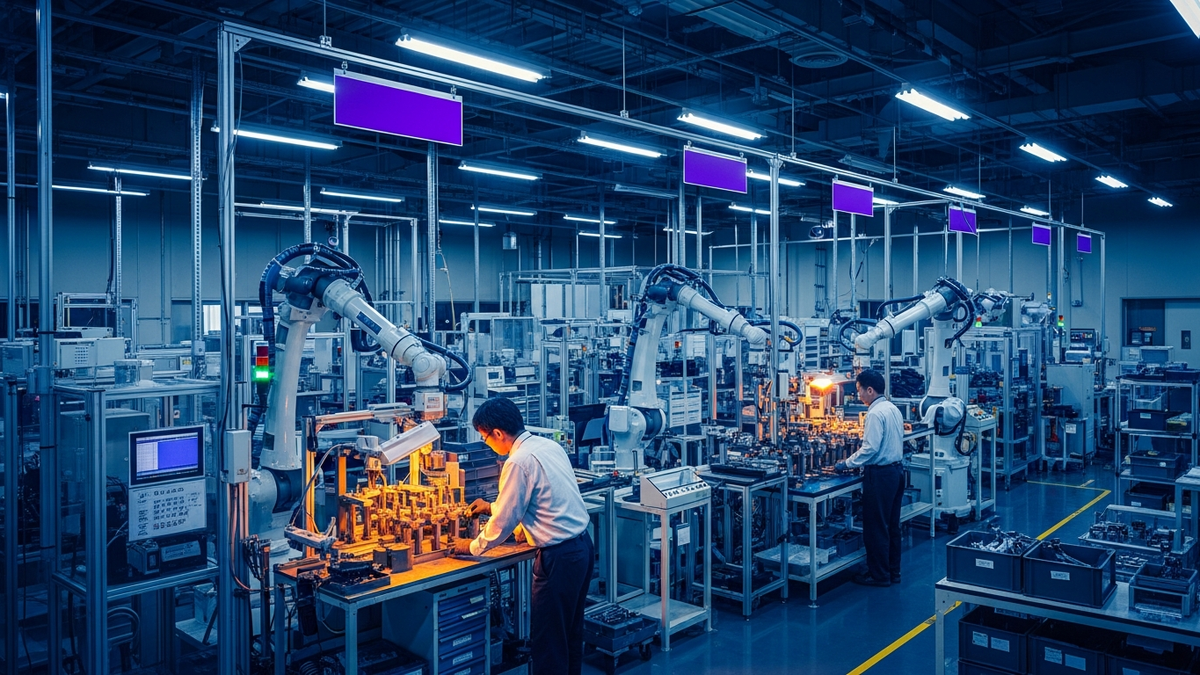
The Mitsubishi Electric Play: Manufacturing as AI's Third Pillar
Mitsubishi Electric announced its investment in Sakana AI on March 25, 2026, a move designed to accelerate the deployment of Sakana's next-generation models into the Serendie digital platform. Serendie is Mitsubishi's enterprise AI system for optimising complex operations:manufacturing processes, energy distribution, supply chains. The integration targets what Mitsubishi calls "tacit knowledge": the unarticulated expertise that makes a factory efficient, a supply chain resilient, or a power grid stable. These are problems that generic foundation models struggle with because they lack the domain data and operational context to reason effectively. This strategy contrasts with Korea's AI position, which emphasises broad foundation-model development alongside hardware optimization.
Ren Ito, Sakana AI's co-founder, framed the collaboration explicitly: "We will position AI use in the manufacturing domain, including physical AI, as our third strategic pillar, following our initiatives in the financial and defence sectors, striving to create innovative solutions that leverage Japan's strengths. By combining Mitsubishi Electric's manufacturing knowledge and extensive datasets with our next-generation AI technologies, we will collaborate to bring AI into practical implementation across society."
This language is revealing. Sakana is not pitching general-purpose intelligence; it is pitching manufacturing AI, financial AI, and defence AI as separate strategic verticals. Each requires domain-specific models trained on domain-specific data. Japan's industrial structure:deep vertical integration, proprietary datasets, long product cycles:favours this approach. A model trained on Mitsubishi's three decades of factory data can optimise production in ways a general-purpose model cannot.
Satoshi Takeda, Mitsubishi Electric's Senior Vice President and Chief Digital Officer, reinforced this: "By strengthening our Serendie digital platform and leveraging generative AI, we are creating new business value and enhancing our competitive position. We are confident this investment will be an important step toward broadening AI's capacity to address concrete, real-world challenges."
The timing is deliberate. Japan's manufacturing sector faces severe labour shortages and energy constraints. Robotics and automation are critical. A factory AI that can predict equipment failures, optimise energy use, and suggest process improvements:using models trained on Japanese industrial data:addresses Japan's most pressing economic problem. This is not research; it is infrastructure for Japanese industrial survival.
MUFG's April Rollout: Finance as Proof of Concept
MUFG, Japan's largest banking group, began a gradual rollout of Sakana AI systems starting April 2026. The deployment is methodical: rather than a "big bang" launch across all banking operations, MUFG is integrating Sakana's models into specific financial applications:risk assessment, trading signals, operational anomaly detection. The rationale is clear: banks cannot afford model failures. A false positive in risk detection or a mispredicted trading signal has real financial consequences. Japanese banks are deeply conservative; they demand proof before deployment. This cautious approach aligns with broader Asia enterprise AI strategies.
MUFG previously collaborated with Sumitomo Mitsui Financial Group on similar AI infrastructure, establishing a pattern of cautious, industry-standard adoption. Sakana AI's advantage is its focus on efficiency: Sakana's models emphasise computational efficiency and reduced parameter count:making them cheaper to run at scale and faster to customise for bank-specific workflows. For a global megabank, cost per inference at scale matters enormously. If Sakana's 32-billion-parameter models can achieve comparable accuracy to 70-billion-parameter competitors while using half the compute, the financial case is obvious.
The April 2026 timing is critical. Japan's AI Basic Act (effective January 2025) and Korea's AI Basic Act (effective January 2026) establish a regulatory baseline. By April 2026, major financial institutions must comply with domestic AI governance standards. MUFG's Sakana deployment demonstrates that Japanese AI governance is not a barrier to deployment:it is a framework that Japanese firms can move within confidently.
By combining Mitsubishi Electric's manufacturing knowledge and extensive datasets with our next-generation AI technologies, we will collaborate to bring AI into practical implementation across society." : Ren Ito, Co-founder, Sakana AI, March 2026
The Cultural AI Angle: Optimising for Japan
Sakana AI's longer-term bet is cultural AI: models that understand Japanese datasets, Japanese business practices, and Japanese cultural context in ways Western models do not. The startup is developing models for miwo, an optical character recognition system for kuzushiji:ancient Japanese scripts. This is not a commercial product; it is a signal. Sakana is saying: "We will build AI tools that solve Japanese problems, even obscure ones, because Japan's conglomerates will fund it." Japan's AI Promotion Act and Korea's AI Basic Act establish distinct policy frameworks that enable such specialised approaches.
This strategy reflects Japan's industrial economics. Japanese conglomerates have deep historical data, proprietary manufacturing techniques, and long-term patient capital. They are willing to fund AI that is optimised specifically for their operations, even if the model cannot be commercialised globally. Sakana is the execution vehicle for this funding.
Tarin Clanuwat, Sakana's Research Scientist, crystallised the approach: "We want to build AI models that actually understand Japanese context: Japanese culture, Japanese society." This is a direct counter to the globalisation logic of Western AI labs. Sakana is explicitly building for Japan first, not building globally and optimising for Japan second.
The limiting factor is compute. Japan's datacenters are smaller than India's or South Korea's. Renewable energy capacity in Hokkaido is constrained. Sakana's efficiency focus:reducing parameter count, computational cost, and energy use:is not purely technical; it is a response to infrastructure constraints. Japan cannot compete on raw compute scale, so it competes on efficiency, domain specificity, and cultural alignment.
The 130-Project Ecosystem: Distribution Over Concentration
Japan hosts over 130 sovereign AI projects globally as of April 2026:the highest count among Asia-Pacific nations. This reflects not dominance but fragmentation. Unlike India's concentrated 62,000-GPU deployment or South Korea's unified government-NVIDIA-Hyundai factories, Japan's approach is distributed: SoftBank's Hokkaido renewable-energy datacenter, MUFG's financial AI, Mitsubishi Electric's manufacturing AI, Sony AI's media applications, Rakuten's e-commerce AI, and dozens of smaller conglomerate initiatives.
This distribution is structural. Japan's economy is built on competing keiretsu (conglomerate groups) and independent regional champions. A unified "national AI champion" is culturally and politically impossible. Instead, Japan tolerates redundancy: multiple firms building overlapping infrastructure, multiple approaches to sovereign AI, multiple datacenters at different scales. This is inefficient by pure economics but resilient by design. If one firm's approach fails, others continue. If geopolitical circumstances change, Japan has optionality across multiple players. This contrasts with unified government-industry AI centers of excellence in other Asia markets.
The trade-off is clear: India and South Korea will build faster, larger, cheaper infrastructure. Japan will build slower, smaller, more specialised infrastructure. Over a 10-year horizon, this may prove advantageous. Japan is optimising for long-term embeddedness in industrial operations, not short-term scaling or leaderboard performance.
Frequently Asked Questions
What is Sakana AI and why does Mitsubishi Electric care?
Sakana AI is a Tokyo-based startup (founded January 2024) focused on manufacturing and financial AI optimised for Japanese operations. Mitsubishi Electric invested in March 2026 to integrate Sakana's models into Serendie, its digital platform for factory and supply-chain optimisation. The partnership targets efficient AI for complex industrial problems.
Why does Japan focus on manufacturing AI instead of frontier models?
Japan faces severe labour shortages and energy constraints. Manufacturing AI that optimises factories, predicts equipment failures, and improves supply chains addresses Japan's core economic problem. Frontier-model leaderboards are less important than deploying AI that keeps Japanese industry competitive.
What is "tacit knowledge" and why does it matter in manufacturing?
Tacit knowledge is expertise that is difficult to articulate:how experienced operators optimise a factory, how to manage a supply chain under stress. AI models trained on domain-specific operational data can learn these patterns in ways generic models cannot. This is why Mitsubishi Electric's datasets are valuable to Sakana AI.
Why is MUFG rolling out Sakana AI gradually instead of broadly?
Japanese banks are risk-averse. A gradual rollout allows MUFG to test Sakana's models on specific financial applications (risk detection, anomaly detection) before deploying across the entire banking system. Conservative deployment is standard in Japanese financial institutions.
How does Japan's 130-project approach compare to India and South Korea?
India is concentrated: 62,000 GPUs in a coordinated IndiaAI programme. South Korea is unified: government-NVIDIA-Hyundai factories. Japan is distributed: SoftBank, MUFG, Mitsubishi, Sony, Rakuten each building separate initiatives. This is less efficient but more resilient.
What is miwo and why is Sakana building it?
Miwo is optical character recognition for kuzushiji (ancient Japanese scripts). It is a signal that Sakana will build AI tools for Japanese-specific problems, even non-commercial ones, because Japanese conglomerates fund R&D with long-term patience capital. This is part of Sakana's cultural AI strategy.