

The AI jobs threat is real, but the story does not end with redundancy
Across Asia-Pacific, the question is no longer whether artificial intelligence will reshape the workforce. It already is. From automated customer service in Manila to algorithmic underwriting in Tokyo, AI-driven automation is compressing timelines that economists once thought would span decades into a matter of years. The fear is palpable, and in many cases, it is justified.
But fear, left unexamined, distorts the picture. The professionals finding themselves most at risk are not simply those whose jobs involve repetitive tasks. They are those who have stopped learning. The ones thriving , in Singapore, Seoul, Sydney, and beyond , share a common trait: they treat AI as a collaborator, not a competitor.
What AI is actually automating , and what it cannot touch
The honest conversation about AI replacing human workers requires precision. AI excels at pattern recognition, data processing, language generation, and decision-making within well-defined parameters. It is already handling tier-one customer queries, generating first-draft marketing copy, analysing medical imaging, and processing legal documents faster than any human team.
What it cannot do reliably , at least not yet , is navigate ambiguity with genuine judgement, build trust in high-stakes relationships, exercise contextual ethical reasoning, or generate truly novel ideas that emerge from lived experience. These are not merely soft skills. They are the hard differentiators that determine whether a professional remains relevant in an AI-augmented economy.
"The question is not whether AI will change your job. It will. The question is whether you will change faster than the technology does." , World Economic Forum, Future of Jobs Report
The skills that age well
- Critical thinking and analytical reasoning , the ability to interrogate AI outputs, not just accept them
- Emotional intelligence and interpersonal communication , still irreplaceable in leadership, care, negotiation, and sales
- Creative problem-solving , framing the right questions is more valuable than generating answers
- AI literacy , understanding how models work, where they fail, and how to prompt them effectively
- Domain expertise combined with adaptability , deep knowledge in a field, paired with the willingness to restructure how that knowledge is applied
The Asia-Pacific Picture: Who Is Getting This Right
Asia-Pacific is not a monolith when it comes to AI workforce adaptation. Some governments and corporations are investing heavily in reskilling. Others are leaving workers to figure it out on their own. The divergence matters enormously for anyone trying to future-proof their career in the region.
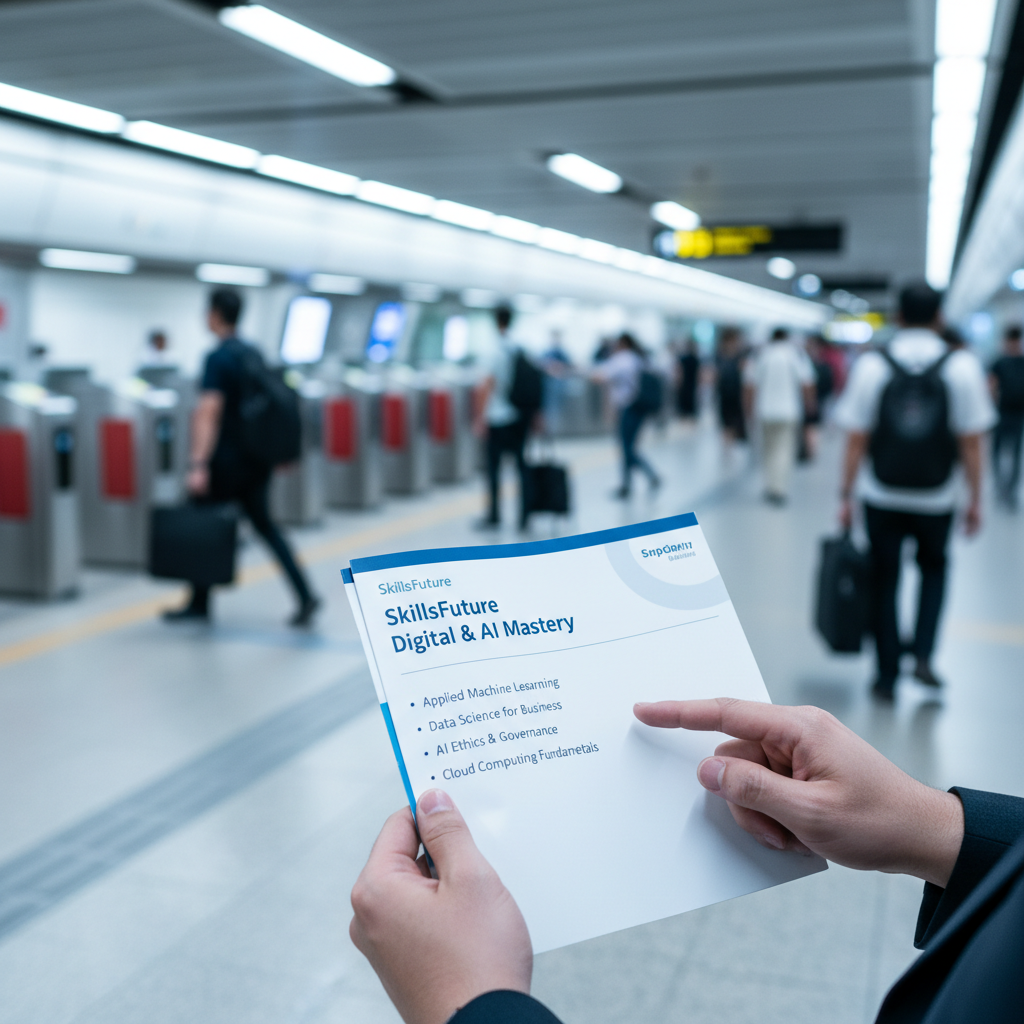
Singapore has been the most deliberate. The government's SkillsFuture initiative, now in its second major phase, provides citizens with credits to pursue AI and digital skills training across hundreds of approved courses. The programme is not perfect , uptake has been uneven across age groups , but the institutional commitment is serious and sustained. Employers including DBS Bank and Singapore Airlines have integrated AI upskilling directly into their internal development pathways.
South Korea presents a different model. The country's creative industries, particularly its entertainment and gaming sectors, have become genuine laboratories for human-AI collaboration. K-pop production studios are using AI for composition assistance, visual effects, and audience analytics , while Korean artists retain creative direction. It is a working example of the augmentation argument: AI as amplifier, not replacement.
"In South Korea's creative economy, AI tools are being adopted not to replace artists, but to extend what a small team can produce at scale." , McKinsey Global Institute, Technology and the Future of Work in Asia
India presents both an opportunity and a warning. The country graduates over 1.5 million engineering students annually, many of whom are entering a market where entry-level coding tasks are increasingly handled by AI coding assistants. The premium is shifting rapidly from writing code to architecting systems, managing AI outputs, and solving problems that require business context alongside technical skill. Indian tech workers who recognise this shift early are repositioning; those who do not face genuine disruption.
Australia and Japan, meanwhile, are grappling with acute labour shortages in sectors like healthcare and logistics where AI is being deployed as much out of necessity as efficiency. In Japan, demographic pressures mean that AI adoption in manufacturing and elder care is being framed not as job elimination but as workforce extension , filling gaps that simply cannot be filled by humans alone.
The evolution framework: how to actually adapt
Acknowledging the need to evolve is easy. Knowing how to do it, practically, is harder. The professionals navigating this transition most successfully are not simply consuming more content about AI. They are restructuring how they work, what they prioritise, and where they invest their learning time.
A practical comparison: static versus evolving professionals
| Static Professional | Evolving Professional |
|---|---|
| Treats AI tools as a threat or a gimmick | Experiments with AI tools weekly and integrates them into workflow |
| Focuses solely on task execution | Focuses on judgement, framing, and oversight of AI outputs |
| Waits for employer-led training | Self-directs learning and builds AI literacy independently |
| Defines value by hours worked or tasks completed | Defines value by outcomes, ideas, and decisions made |
| Avoids unfamiliar tools | Actively seeks discomfort as a signal of growth |
The reality of how people are actually using AI in 2025 reveals a significant gap between hype and practice. Many workers have access to powerful AI tools but are using them only for surface-level tasks. The competitive advantage belongs to those who go deeper: learning to prompt well, understanding model limitations, and building hybrid workflows that combine human judgement with machine speed.
There is also a darker side to this productivity arms race that deserves honest acknowledgement. The pressure to use AI tools continuously, to always be optimising, and to maintain output levels that were previously impossible is generating real cognitive strain. The phenomenon of AI-induced cognitive overload is emerging as a genuine workplace issue, particularly in high-intensity sectors across Asia where productivity culture is already intense.
For organisations: the reskilling imperative
Individual adaptation matters, but it operates within structures set by organisations. Companies that treat AI adoption as a cost-cutting exercise , deploying automation while quietly reducing headcount without investing in the remaining workforce , are taking a short-term view that will cost them dearly. The real competitive advantage in an AI economy is not having fewer humans. It is having humans who are exceptionally good at working with AI.
The opportunities for smaller businesses in the AI era are particularly significant here. SMEs that cannot afford large-scale redundancy-and-replacement programmes are finding that investing in AI literacy across their existing teams produces faster returns than hiring AI specialists from scratch. The organisations winning this transition are not always the biggest spenders on AI infrastructure. They are the ones investing most deliberately in human capability.
This is not charity. It is strategy. The professionals who understand AI's limitations , who can catch its errors, challenge its outputs, and apply contextual judgement that no model currently replicates , are precisely the ones organisations need most as AI deployment scales. Reskilling is not altruism. It is competitive positioning.
Frequently Asked Questions
Will AI replace most jobs in Asia in the next decade?
Not most jobs outright, but it will significantly change the majority of them. Research consistently shows that whole-job automation affects fewer than 5% of roles end-to-end, but partial automation of tasks within roles is far more widespread. The professionals most at risk are those who perform primarily routine, codifiable tasks without investing in complementary skills that AI cannot replicate.
What skills should I develop to stay relevant in an AI-driven economy?
Prioritise a combination of AI literacy (understanding how to use and critically evaluate AI tools), domain expertise in your field, and the human capabilities that AI struggles to replicate: critical thinking, emotional intelligence, creative problem-solving, and communication. The most durable career positioning combines deep knowledge with genuine adaptability.
Which Asia-Pacific countries are doing the most to prepare workers for AI?
Singapore is widely regarded as the regional leader, with its SkillsFuture programme providing structured, government-backed pathways for AI and digital upskilling. South Korea has invested significantly in AI R&D and workforce development, while Japan is integrating AI to address demographic workforce gaps. India's large tech workforce is navigating a rapid shift in what skills command a premium as AI coding assistants become mainstream.
We want to know: what is the single most valuable human skill you believe AI will never replicate in your industry, and are you actively developing it? Drop your take in the comments below.