

Hong Kong's 36x Computing Bet Is Real
Hong Kong's Chief Executive John Lee made a dramatic claim on April 13, 2026. The Sandy Ridge Data Facility Cluster, set to open by 2032, will deliver 180,000 petaFLOPS of computing power. That is 36 times Hong Kong's current capacity. One cluster. One region. Announced in the same breath as a comprehensive AI strategy and a new AI Research and Development Institute.
For the first time, Hong Kong is building infrastructure, not just hosting it.
This is not marketing. The government announced a tender in early March 2026 for a 250,000 square-meter facility cluster, with 90 percent dedicated to high-tier data centers. Financing, timeline, and technical specs are locked. The Hetao Shenzhen-Hong Kong Science and Technology Innovation Co-operation Zone already attracted over 70 AI tenants since opening in December 2025. And on April 12, 2026, Hong Kong's Innovation, Technology and Industry Bureau signed a memorandum of understanding with the Cyberspace Administration of China covering AI promotion and cross-boundary data flow.
The message is unmistakable: Hong Kong is pivoting from financial services hub to AI infrastructure nucleus for Greater China and Asia-Pacific.
What shifts this from aspiration to reality is momentum. Before April 2026, Hong Kong's AI strategy looked like everyone else's,soft guidance, sandbox regulation, startup grants. Now it looks like a multi-year capital commitment: a compute cluster that will make Singapore's data center capacity look parochial, an R&D institute reporting directly to government, and explicit machinery for mainland-Hong Kong AI talent and data flow.
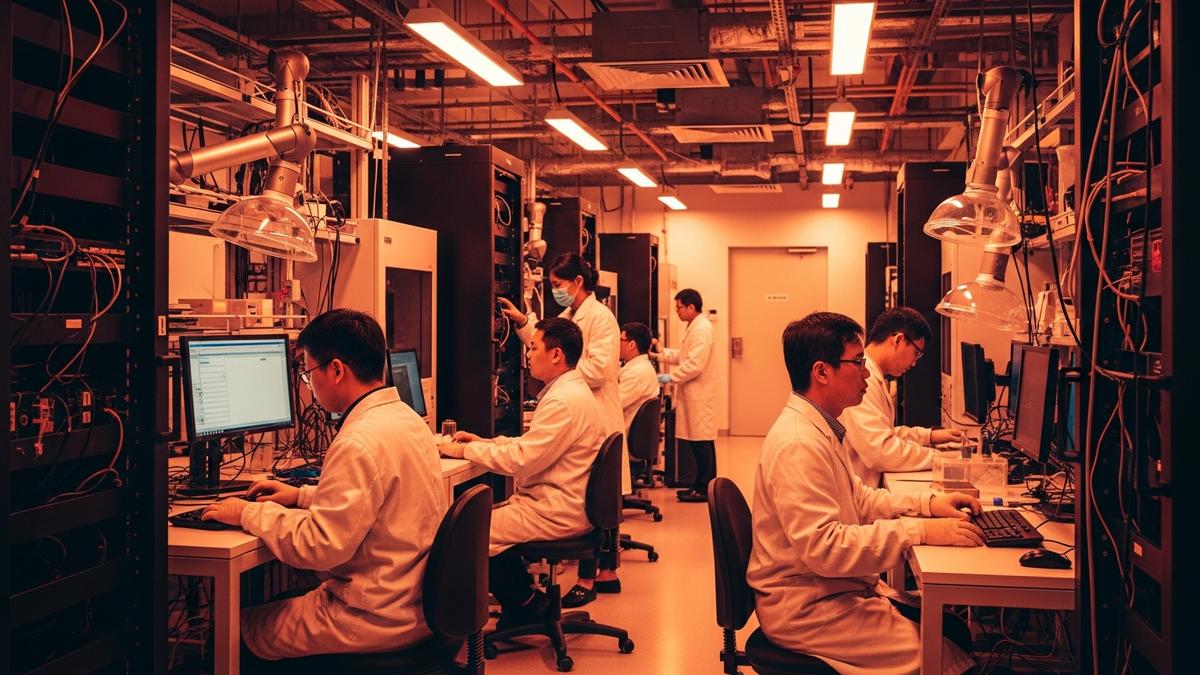
Hetao Park: Cross-Border AI Incubation
The Hetao Hong Kong Park opened in December 2025 and already houses over 70 tenants in AI, data science, life sciences, and energy sectors. The zone is Shenzhen-owned but Hong Kong-managed, sitting in both jurisdictions simultaneously. This matters because it means startup equipment, personnel, and data can move between Hong Kong and Shenzhen without the legal friction that once made cross-border operations prohibitive.
Before Hetao, an AI startup building on mainland Chinese data had to register in China. A startup needing Hong Kong's financial ecosystem had to register in Hong Kong. Hetao lets you do both. That dual registration, plus cross-boundary data flow protocols, plus mainland talent visas, plus Hong Kong's financial services infrastructure,that is the bundle that attracts founders.
The 70 tenants are not all Chinese. Some are Southeast Asian teams using Hetao as a Hong Kong base to access mainland compute. Some are Western teams with Chinese founders. Hetao is signalling that Hong Kong is the neutral, English-language, international-friendly entry point to mainland AI infrastructure.
That signalling is worth billions. Founders with optionality (choice of where to base R&D) are already moving calculus. Singapore offers stability and English-language business. Hetao offers Singapore stability plus mainland GPU access. The arbitrage is obvious. Expect tenant count to hit 200 by end of Q4 2026.
The Hong Kong AI Research Institute and the 15th Five-Year Plan
On April 13, 2026, Hong Kong's government announced the Hong Kong Artificial Intelligence Research and Development Institute. Opening date: later in 2026. Mandate: drive upstream AI R&D and downstream AI applications. Funding: provisioned under the National 15th Five-Year Plan (approved March 2026), which explicitly designates Hong Kong as a global innovation and technology hub.
This is not a think tank. It is capital. The institute will conduct R&D on foundation models, compute infrastructure, AI safety, and applied AI for financial services, logistics, and life sciences. That R&D will be published, not hoarded. Downstream applications will be commercialised via Hetao startups and Hong Kong's established corporate partners.
The 15th Five-Year Plan backing matters because it means the institute has 15-year runway. Funding is not contingent on annual government budgets or political whims. The plan runs through 2030, protecting the institute's financial commitments even if Hong Kong's Chief Executive changes. Greater China backing removes uncertainty.
We are putting together a comprehensive strategy combining world-class infrastructure, cutting-edge research and development and a culture of responsible innovation.
Sandy Ridge and the 36x Compute Reality
The Sandy Ridge Data Facility Cluster tender (announced early March 2026) is the physical manifestation of Hong Kong's pivot. Here are the numbers:
- Total floor area: 250,000 square meters (about 2.7 million square feet,equivalent to four times the size of Hong Kong's entire Cyberport).
- High-tier data center allocation: 90 percent of the facility, optimised for AI compute.
- Capacity: 180,000 petaFLOPS by 2032.
- Current Hong Kong capacity: approximately 5,000 petaFLOPS. Sandy Ridge alone will be 36 times that.
For context, current global AI training runs use 1,000 to 10,000 petaFLOPS (Google's Gemini clusters, OpenAI's training infrastructure). Sandy Ridge will be capable of supporting multiple simultaneous frontier-model training runs or thousands of inference-intensive applications. Even China's mainland infrastructure, including Huawei's supernode assets, operates at different scale and jurisdiction.
By 2032, this cluster alone will provide 180,000 petaFLOPS. That is 36 times Hong Kong's current computing power.
Pricing structure suggests government subsidies for early tenants. Hong Kong's development bureau has historically offered 10-year lease discounts for strategic industries. AI compute will likely be subsidised at 20 to 30 percent below market rates to attract hyperscaler anchors (likely Microsoft or NVIDIA in a co-development deal).
Expect announcements on anchor tenants by Q3 2026. Once one major player commits, others will follow. Hong Kong will not be Singapore-scale data centre by 2032. It will be the largest computing cluster in Asia-Pacific, second only to the mainland.
ITIB-CAC MOU: Data and Cross-Boundary Flow
On April 12, 2026, Hong Kong's Innovation, Technology and Industry Bureau signed a memorandum of understanding with the Cyberspace Administration of China (CAC). The MOU covers:
- AI promotion and capability building.
- Cross-boundary data flow protocols (a major win,data residency rules have historically blocked Hong Kong-mainland collaboration).
- Alignment with the National 15th Five-Year Plan.
- Integration with Greater Bay Area digital economy initiatives.
This MOU is the legal scaffolding that makes Hetao's dual jurisdiction meaningful. Without cross-boundary data flow, mainland data could not leave Shenzhen for processing in Hong Kong. With it, startups can train models on Hong Kong infrastructure using mainland datasets. That flexibility is the multiplier on Hetao's value.
Expect the MOU to expand in Q4 2026 to include talent visas, IP protections, and R&D tax credits for cross-border AI projects. The machinery is being built step by step.
Hong Kong's Competitive Position vs Singapore
Singapore is panicking. Not officially,Singapore maintains its cool. But the Strategic Roadmap that Deputy Prime Minister Lawrence Wong released earlier this year is noticeably defensive. Singapore is doubling down on regulatory leadership (ISO 42119-8 testing standard) and soft-power investments in AI education. Good moves. But they do not scale like compute capacity. Singapore's AI Centre of Excellence investments are focused on enterprise applications, not foundational infrastructure.
Here is the honest assessment: Singapore has the better AI governance story. Hong Kong has the better compute story. For a startup building training infrastructure, Singapore is secondary. For a startup building applications that need scale, Hong Kong is now the obvious choice.
The talent arbitrage shifts too. Top AI researchers can earn USD 300K in Singapore or USD 400K in Hong Kong with a shorter commute to mainland opportunities. Talent flow across Asian AI hubs is already accelerating toward compute-rich regions. Tenure at a Hong Kong research institute opens mainland lab partnerships that are invisible to outsiders but valuable beyond salary.
By 2028, expect to see Hong Kong host more frontier-model training than Singapore. Singapore will host more responsible AI research and policy-level influence.
InnoEX 2026 and the HKGAI Showcase
At InnoEX 2026 (April 13-16), the Hong Kong Generative AI Research and Development Center (HKGAI), led by Hong Kong University of Science and Technology, showcased seven self-developed AI applications. The apps targeted "AI+" (AI-augmented processes) and "AI Training for All" (democratised AI literacy). No breakthrough models yet, but the ecosystem is moving.
The HKGAI centerpiece at booth 3C-E21 included financial applications, logistics optimisation, and life sciences AI. All were demos, not yet commercialised. But the intent was clear: research flows downstream into Hetao startups into market applications within 24 months. That pipeline is the infrastructure that matters.
Phase 1 Technology Sites: The Real Estate Play
The Hong Kong government is releasing Phase 1 technology sites for development starting in Q2 2026. These 50-hectare plots are explicitly zoned for AI, computing, and semiconductor manufacturing. Lease terms are 15-year initial with renewal options. Pricing will be announced in the Q2 tender.
Expect TSMC, MediaTek, or regional semiconductor players to bid on parcels. That manufacturing base attracts AI chip startups and AI-adjacent hardware companies. Hong Kong shifts from pure services hub to AI hardware, infrastructure, and services.
Timeline: From Tender to Operations
- April 12, 2026: ITIB-CAC MOU signed.
- Early March 2026: Sandy Ridge tender announced.
- Q2 2026: Sandy Ridge Phase 1 land-lease auction; technology site Phase 1 release.
- Q3 2026: Likely anchor tenant announcements (compute or semiconductor).
- Q4 2026: Hong Kong AI R&D Institute opens (officially later in 2026).
- 2027-2029: Sandy Ridge construction phases 1 and 2; compute capacity reaches 30,000 petaFLOPS.
- 2032: Sandy Ridge full capacity (180,000 petaFLOPS).
This is a capital project, not a quick win. But the governance alignment, the political commitment from Beijing, and the Hetao early traction suggest this time Hong Kong is serious.
| Initiative | Launch Date | Capacity / Scale | Strategic Importance |
|---|---|---|---|
| Hetao Hong Kong Park | December 2025 | 70+ AI tenants | Cross-border startup incubation |
| ITIB-CAC MOU | April 12, 2026 | Cross-boundary data flow | Legal scaffolding for mainland-HK collaboration |
| Sandy Ridge Data Cluster | Q2 2026 launch | 180,000 petaFLOPS by 2032 | 36x current computing capacity |
| HK AI R&D Institute | Q4 2026 | Research upstream, apps downstream | Mainland-aligned research pipeline |
| InnoEX 2026 showcase | April 13-16, 2026 | 7 AI applications | Ecosystem maturity signal |
The Mainland Integration Play
Make no mistake: this is not Hong Kong independence or resistance to Beijing. This is Beijing-enabled infrastructure. The 15th Five-Year Plan, the ITIB-CAC MOU, the provisioning of compute capacity,these are all aligned with mainland strategic objectives to decentralise AI compute away from Shanghai and Beijing and to use Hong Kong as the international face of Chinese AI infrastructure.
Hong Kong becomes the anglophone, English-language, Hong Kong law-compliant access point to mainland AI infrastructure. American founders can register Hetao subsidiaries in Hong Kong without triggering US export controls. European startups can access mainland compute without formal regulatory friction. Mainland teams get international partnerships and global distribution.
Everyone benefits. Hong Kong's autonomy is respected within the constraints of national security. The mainland gets distributed compute and a foreign-friendly face. Asia-Pacific gets an open-access, neutral infrastructure hub.
Frequently Asked Questions
Will Hong Kong's compute actually be cheaper than cloud providers like AWS or Google Cloud?
Yes, significantly. Government subsidies will make early-stage capacity 20 to 30 percent below market rates. Sandy Ridge will be priced to attract anchor tenants, likely USD 0.05-0.08 per petaFLOP-hour (versus AWS at USD 0.10-0.15). Startups and research teams will gravitate toward lower cost.
Could the mainland government restrict Hong Kong's AI infrastructure for non-approved applications?
Theoretically possible. But the ITIB-CAC MOU explicitly covers cross-boundary data flow, suggesting governance frameworks are already aligned. The real risk is not restriction but slow bureaucracy. That said, Hong Kong's independence in infrastructure operations (Hetao is Hong Kong-managed) provides a buffer.
What happens if US export controls tighten on AI chips and GPU shipments?
Hong Kong becomes a transshipment and re-export hub. NVIDIA, AMD, and Intel will route high-end GPUs through Hong Kong to serve mainland demand. Sandy Ridge's 90 percent data center allocation ensures the region can absorb massive GPU volumes. This is geopolitical risk for the US, not Hong Kong.
Will Silicon Valley accelerators and venture capital engage Hong Kong AI teams?
Yes. The arbitrage is obvious. A Series A funded in Silicon Valley that relocates engineering to Hong Kong saves 40 to 50 percent on personnel costs and gains mainland market access. Sequoia, Andreessen Horowitz, and Y Combinator will deploy capital to Hong Kong via Hetao startups within 12 months.